Log in
Hanoi

Hanoi launches first bus route linking city center to Minh Chau island commune

Hanoi expands public transport with first bus route to its island commune Minh Chau, marking a breakthrough in public transport accessibility for residents living along the Red River.

THE HANOI TIMES — Hanoi inaugurated its first bus route linking the city center to Minh Chau, the capital’s only island commune, on October 14, roughly 60 kilometers west of the city.

The bus route, coded 20ATC, starts from Nhon Bus Station and ends in Minh Chau Commune. It operates daily from 4:40 AM to 7:50 PM, with trips every 30 minutes to 50 minutes.
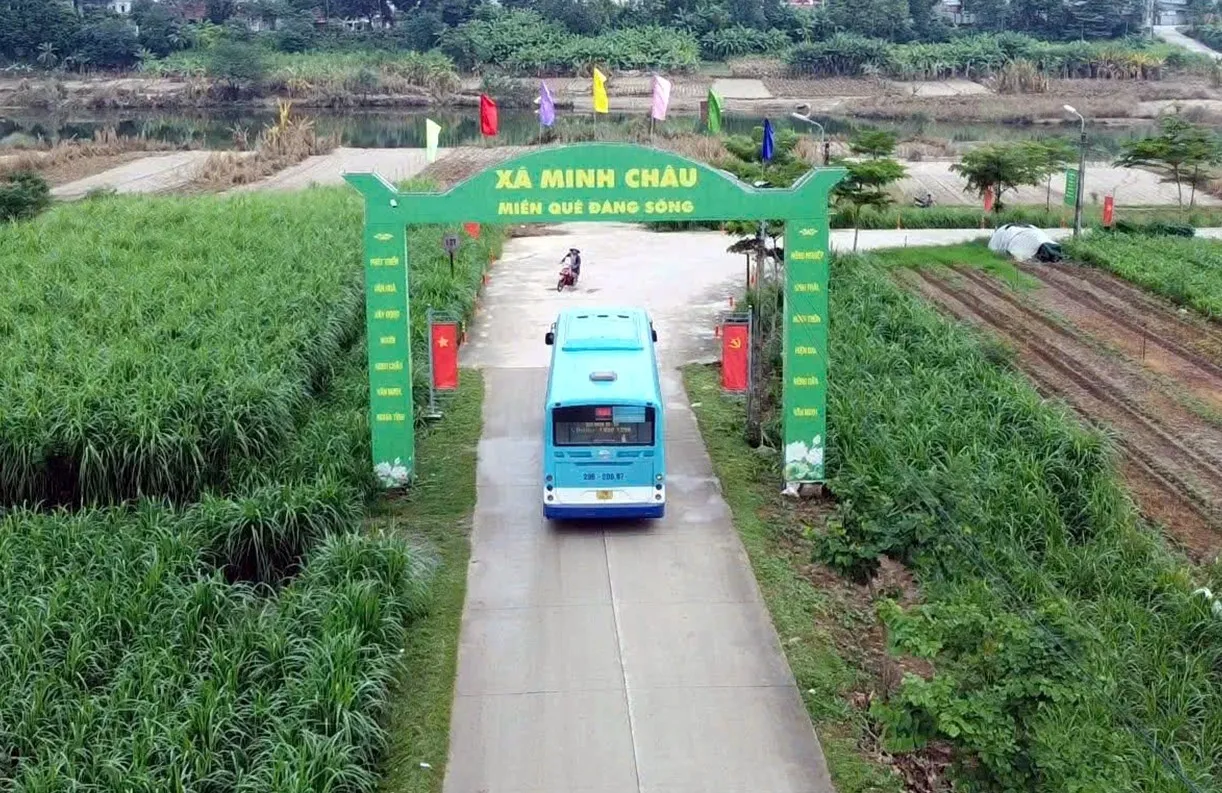
Hanoi has launched a new bus route connecting the central areas to its island commune of Minh Chau, located about 60 kilometers to the west. Photo: Transerco

The service results from cooperation between the Hanoi Transport Corporation (Transerco) and relevant city departments to expand the capital’s public bus network.

According to Dinh Tuan Anh, Vice Chairman of the commune People’s Committee, Minh Chau lies in the middle of the Red River, where the Red, Da and Lo rivers meet. The commune has long struggled with transportation challenges.

Residents relied on ferries to reach Quang Oai Commune or crossed a spillway to Vinh Phu Commune in Phu Tho Province, he said.

“Surrounded by water, transportation has remained difficult for the people and limited local socio-economic development, education and cultural exchange,” he added.

“Hundreds of people have struggled to commute daily for work, study and medical treatment. We need a safe and stable public transport route,” he said.

The launch of the new bus route marks a milestone, improving access to trade, tourism, education and daily travel for local people, the vice chairman said.

Transerco General Director Nguyen Thanh Nam said that the operation of route 20ATC reduces pressure on road traffic and opens opportunities for local trade, services, education and tourism.

He added that the new service expands Transerco’s coverage, bringing the city’s buses to more distant and less accessible communities.

From January to September 2025, Transerco maintained stable operations, running over 2.4 million trips, equivalent to 96% of the plan and serving about 162 million passengers.

The company now operates 44 contracted bus routes, has adjusted timetables on 22 routes and optimized 14 others.

During the same period, Transerco deployed 63 electric buses and installed 247 charging poles at 14 locations to support Hanoi’s green transport goals.

The corporation also provided nearly 5,100 additional bus trips during the celebration of the 80th anniversary of the National Day to meet the transportation needs of residents and visitors.

In the last quarter of 2025, Transerco plans to continue upgrading its electronic ticketing system, apply new digital technologies to improve service quality and expand eco-friendly bus routes to more suburban areas.

Reactions:
Share:
Trending
Most Viewed
Related news
Hanoi nurtures cultural soul through urban change

Hanoi nurtures cultural soul through urban change

14 Oct, 13:34

By keeping culture at the heart of its strategy and empowering citizens as creators, Hanoi can grow sustainably and remain a city with a soul, where every step connects with living memory.

Hanoi entrepreneurs call for bold reforms to drive sustainable economic growth

Hanoi entrepreneurs call for bold reforms to drive sustainable economic growth

14 Oct, 09:05

As Vietnam celebrates the Entrepreneurs’ Day (October 13), business leaders and economists highlight the growing influence of Hanoi’s entrepreneurs and express hopes that the city’s upcoming 18th Party Congress will deliver breakthroughs in policy, infrastructure and the business environment.

Hanoi Metro displays digital ticketing technologies at major international railway exhibition

Hanoi Metro displays digital ticketing technologies at major international railway exhibition

Hanoi Metro presented new digital ticketing and payment technologies at VRT & CONS 2025, highlighting its goal to build a modern, safe and smart public transport system for the capital.

Phung Thi Hong Ha elected Chairwoman of Hanoi People’s Council for 2021-2026

Phung Thi Hong Ha elected Chairwoman of Hanoi People’s Council for 2021-2026

With years of leadership experience and strong commitment to public service, Phung Thi Hong Ha takes on a key role in Hanoi’s political system as she becomes Chairwoman of the Hanoi People’s Council for the 2021-2026 term.

Nguyen Duc Trung elected Hanoi Mayor for 2021–2026

Nguyen Duc Trung elected Hanoi Mayor for 2021–2026

The newly-elected chairman pledges innovation, accountability and public-centered governance to drive Hanoi’s transformation into a modern and global capital.

Hanoi digitizes transport data through iHanoi platform

Hanoi digitizes transport data through iHanoi platform

The system will collect and update citizen data on vehicle owners and users while using data analytics to cross-check, standardize and verify vehicle and driver license records.

Hanoi plans large-scale testing and inspection hubs

Hanoi plans large-scale testing and inspection hubs

Such an inspection and testing center will be regional in scale and meet international standards.

Hanoi to host 2025 International Culinary Festival celebrating global and Vietnamese flavors

Hanoi to host 2025 International Culinary Festival celebrating global and Vietnamese flavors

Hanoi will host the 2025 International Culinary Culture Festival on November 22–23, featuring 120 booths from embassies and cultural centers to promote Vietnamese and global culinary heritage.

Vietnam to raise emission bar for older cars in 2026

Vietnam to raise emission bar for older cars in 2026

The policy will first be implemented in areas with severe air pollution such as Hanoi and Ho Chi Minh City.

Hanoi pursues sustainable waste sorting inspired by global models

Hanoi pursues sustainable waste sorting inspired by global models

As Hanoi aims to develop consistent waste sorting habits, long-term policies, public awareness and economic incentives are seen as key to building a sustainable waste classification system.