Hanoi lays out nine strategic growth centers for 100-year vision
Hanoi is projected to require more than US$2.67 trillion by 2045 to rebuild its urban system and realize the 100-year master plan vision.
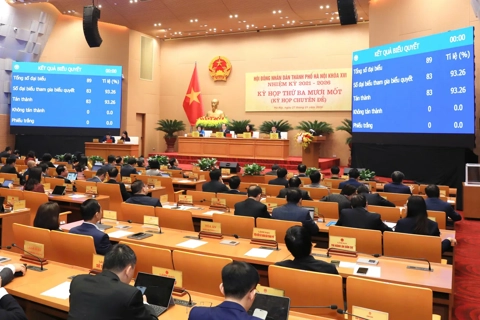
THE HANOI TIMES — Hanoi has outlined nine strategic growth centers as the backbone of its 100-year development vision after the municipal People’s Council on January 27 approved the key orientations of the Capital Master Plan.
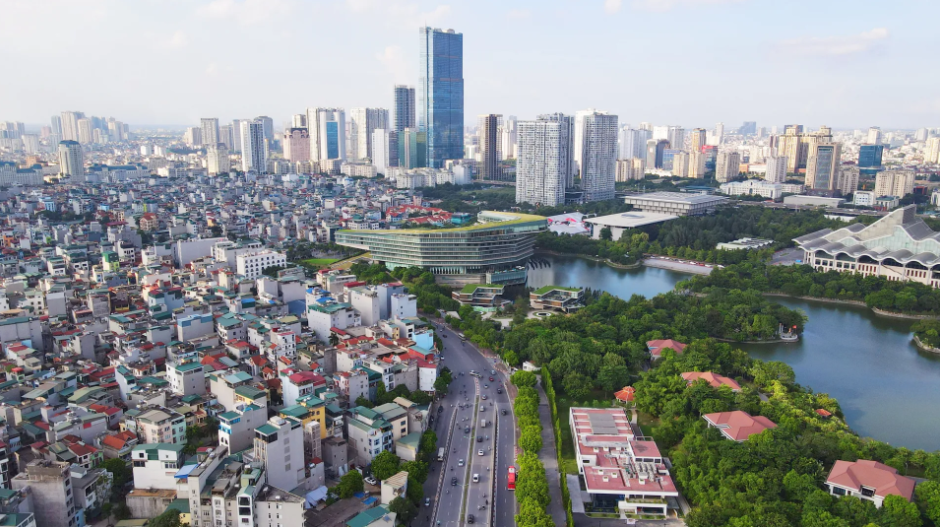
Hanoi from above. Photo: Pham Hung/The Hanoi Times
The plan structures Hanoi around nine growth poles, nine major urban centers and nine dynamic corridors within a multi-layered, multi-tiered urban system aimed at guiding long-term expansion and governance.
The proposal integrates the previously approved Capital Planning and Capital General Planning to address overlaps caused by earlier plans prepared under different legal frameworks, procedures and periods.
Based on Resolution 258 issued by the National Assembly last December, Hanoi is allowed to prepare a single comprehensive master plan, which details national and regional planning and integrates the contents of the two earlier plans.
The city has therefore developed a new proposal with a long-term vision extending to 2100.
Under the new orientation, the capital’s space is defined as a unified urban system developed as a multi-polar and multi-centered urban cluster.
The city will have nine development poles linked to nine major centers, separated by green corridors, green belts, green wedges, rivers and lakes and connected by ring roads and radial transport systems.
The central urban area on the right bank of the Red River is identified as the expanded historical core, forming a pole for culture, history and politics along with an Olympic urban space. The northern pole covering Dong Anh, Me Linh and Soc Son is oriented toward international services, trade, finance and logistics linked to Noi Bai International Airport and the high-tech industry.
The eastern pole in Gia Lam and Long Bien serves as the eastern gateway, developing modern trade, services and logistics connected to National Highway 5 and the Hanoi–Hai Phong Expressway. The southern pole in Thuong Tin and Phu Xuyen is oriented toward industry, logistics and a multimodal transport hub associated with the second airport in southern Hanoi and the high-speed railway.
Another southern pole covering Van Dinh and Dai Nghia focuses on eco-urban development and river landscapes linked to heritage, spiritual spaces and the second southern airport. The southwestern pole in Xuan Mai and Chuong My is oriented toward education, training, healthcare and eco-resort development.
The western pole in Hoa Lac serves as a science and technology city for innovation and education, centered on the Hoa Lac Hi-Tech Park and Vietnam National University. The northwestern pole in Son Tay and Ba Vi is planned as a cultural and historical city with resort tourism linked to national defense and security tasks. The Red River corridor is identified as a special landscape pole combining finance, trade, services and tourism.
Expanding underground spaces
A new feature of the plan is vertical urban organization to use land more efficiently and ease pressure on the core area. Underground space will be layered to accommodate technical infrastructure, parking, commercial centers, underground plazas and public facilities.
Deeper layers are reserved for underground transport systems, urban railways, technical infrastructure and flood control works. The deepest layer serves strategic infrastructure related to security, defense and underground urban rail lines.
Ground level is prioritized for public spaces, greenery, water surfaces, walking areas and heritage conservation. Above ground, the city plans high-density mixed-use complexes at TOD (transit-oriented development) nodes and along ring roads, connected by pedestrian bridges. The plan also studies space for low-altitude aerial vehicles serving transport, logistics and urban tourism while allocating higher airspace for aviation management, telecommunications, meteorology and defense.
During the 2026–2035 period, Hanoi plans to mobilize about VND14,500 trillion (US$604 billion) in total social investment. GRDP is expected to grow by an average of 11.25% per year, reaching about US$203 billion with a per capita income of around US$19,350.
In the 2036-2045 period, total social investment is projected at about VND50,340 trillion ($2.10 trillion). GRDP is expected to continue growing at an average of 11.25% per year, reaching about US$670 billion with a per capita income of around US$44,300.
After approval by the municipal People’s Council, the proposal will be further finalized and submitted to competent authorities for consideration and approval in accordance with regulations.