Hanoi may gain power to demolish unsafe apartments
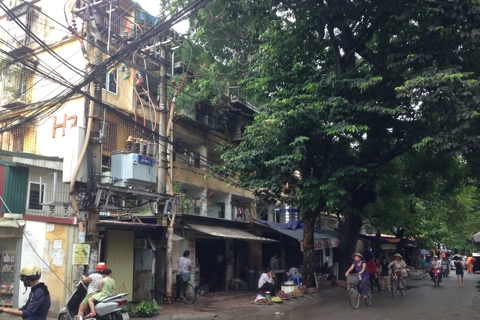
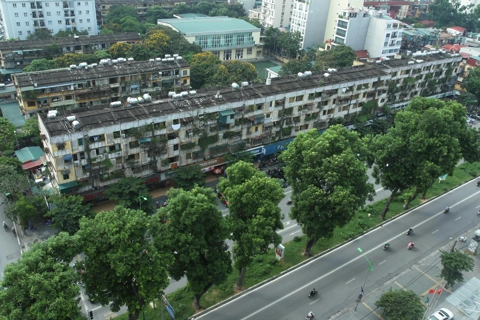
Hanoi is set to receive greater authority to rebuild deteriorated apartment buildings, a long-standing challenge the city has struggled to resolve for years.
THE HANOI TIMES — Hanoi may soon be allowed to order compulsory demolition of aging apartment blocks with just 75% homeowner consent, under a draft resolution submitted to the National Assembly today [December 8], a major shift aimed at breaking years of redevelopment deadlock.

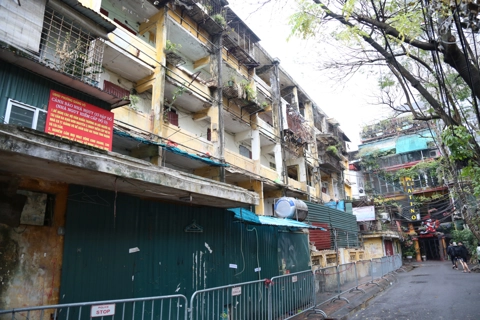
Thanh Cong’s aging apartment block in Ba Dinh Ward. Photo: Hai Linh/The Hanoi Times
Finance Minister Nguyen Van Thang presented the proposal as part of a package of pilot mechanisms for large-scale projects in the capital.
He said redevelopment of degraded buildings has long been stalled, posing risks to public safety and disrupting daily life, and that stronger decision-making power for the city is needed to accelerate upgrades.
To address this bottleneck, the drafting committee recommends giving Hanoi the power to order demolition once over 75% of homeowners or landholders consent, equal to at least 75% of the residential land area within the redevelopment zone.
Under the 2023 Housing Law, projects to rebuild deteriorated apartment buildings can proceed only when 80% of owners agree on compensation, resettlement and reconstruction plans.
For high-risk level D buildings that are severely damaged and unsafe, provincial authorities may decide the most suitable approach.
In practice, achieving such a high approval rate is difficult for redevelopment projects. Investors also struggle to proceed because building density is restricted, the number of floors cannot increase enough to create sufficient commercial units to cover construction and compensation costs.
Reviewing this provision, Chairman of the National Assembly’s Economic and Financial Committee Phan Van Mai said mechanisms with broad impacts such as expanding land recovery, authorizing Hanoi to approve projects instead of the National Assembly or the Prime Minister, or permitting enforcement at 75% agreement must be assessed carefully to avoid disputes and protect social stability.
Hanoi began redeveloping old apartment complexes in 2005. By mid-last year the city had completed only 19 projects and put them into use while more than a dozen others were still underway.
During discussions, Professor Hoang Van Cuong, a member of the Economic and Financial Committee, said regulations on rebuilding old apartments need to be eased.
He noted that without a 75% consent mechanism and flexibility to exceed planning, architectural and population limits, the city will struggle to renew unsafe and deteriorated buildings.
Meanwhile, Trinh Xuan An of the National Defense and Security Committee suggested lowering the approval threshold to 50% instead of 75% to make redevelopment feasible.
Nguyen Truc Anh of the Economic and Financial Committee said the 75% threshold is still high and many countries allow rebuilding when only half of owners agree. He also recommended delegating more authority to commune-level governments for compensation and land clearance to avoid cases where projects remain stuck for 20 years.
Under the draft resolution, developers would prepare detailed plans for redevelopment or urban renewal projects and the approving agency could set planning, architectural and population indicators above current limits in historic inner-city areas.
To speed up major projects, the draft authorizes the Hanoi People’s Council or the Chairman of the municipal People’s Committee to approve investment policies instead of seeking approval from the National Assembly or the Prime Minister. Some projects in this group, excluding apartment redevelopment, may also select contractors or investors under special circumstances.
According to the government, major projects include public investment, public-private partnership projects or projects that must begin immediately under directives from competent authorities.
The group also covers projects funded by the local budget and those for strategic investors with a total investment of at least VND30 trillion (US$1.25 billion), along with redevelopment and urban renewal programs.
For projects that must begin under higher-level directives, the city may apply compensation, support and resettlement rates up to twice the standard level.
These projects may conduct planning steps and start construction at the same time as investment approval procedures.
Regarding urban renewal, Professor Hoang Van Cuong recommended applying a transit oriented development model so high-rise buildings include metro stations and underground commercial spaces.
He said the historic inner-city boundary should also be revisited and limited to areas that genuinely require preservation such as the Old Quarter, Ba Dinh and the old Tay Ho area.
He argued that including Hai Ba Trung and Dong Da on this list restricts the city and residents because these districts contain large numbers of low-rise homes and deteriorated apartment buildings that need redevelopment.
The National Assembly is expected to vote on the draft resolution on December 11.