Hanoi needs US$53 billion to ease gridlock by 2030
The core of Hanoi’s traffic reduction strategy is closely aligned with the city’s green transition goals to ease congestion and build a cleaner, more sustainable urban transport system.
THE HANOI TIMES — The estimated minimum funding required to implement Hanoi’s traffic congestion reduction plan for the 2025–2030 period and beyond is approximately VND1.4 quadrillion (US$53 billion) allocated across different phases.
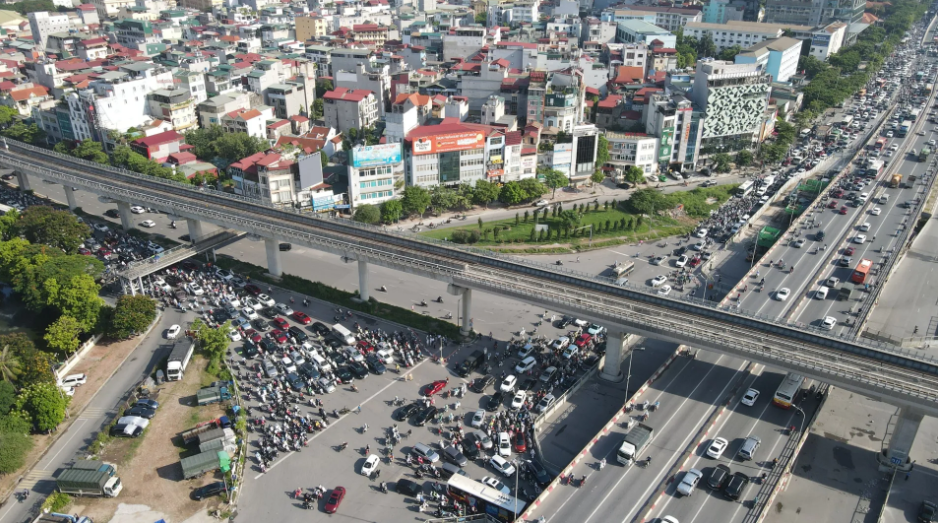
Traffic at Mai Dich intersection, Hanoi. Photo: Pham Hung/The Hanoi Times
The 2025–2030 phase is projected to require about VND569.04 trillion (US$21.6 billion), with 57.1% earmarked for urban railway development and 37.8% for road infrastructure, according to the draft plan prepared by the Hanoi Department of Construction and its consulting partners.
For the 2031–2035 phase, the estimated need is around VND828.07 trillion (US$31.4 billion), of which 79.2% will go to urban railways and 17.6% to road networks.
According a consulting unit, the draft plan proposes 11 solution groups with 116 specific actions and tasks. These include expanding the urban railway and public transport systems, managing traffic demand, controlling existing vehicle fleets, organizing traffic flow and applying information technology in traffic management and operations.
Supply–demand management measures focus on controlling vehicle ownership and use, regulating traffic by time and space, expanding road space and developing networks of railways, buses, shared transport and non-motorized mobility.
The core of the traffic reduction strategy is integrated with Hanoi’s green transition goals. Policy mechanisms will be developed into implementation plans to operationalize the Capital Law and Directive No. 20/CT-TTg of the prime minister on urgent environmental protection measures.
Other priorities include promoting transit-oriented development (TOD) and relocating facilities out of the city center to ease congestion.
A key focus will be investment in urban railway systems, with a target of completing about 96.8 kilometers by 2030 and 301 kilometers by 2035.
A critical and long-term task is building a comprehensive traffic database, particularly detailed data on vehicles. The plan also calls for tighter management of newly registered vehicles and controls on existing ones based on type, age, emissions, time and location of operation.
Transport expert Phan Le Binh noted that the draft plan is thorough and comprehensive.
“It combines institutional and policy measures with infrastructure development, demand management and public awareness campaigns,” said Binh.
The plan also identifies the estimated capital requirements for each five-year period, providing a foundation for the city to prepare necessary investment resources, he added.
Official data show that Hanoi currently has around 9.2 million registered motor vehicles. The annual growth rate is 4%–5% with occasional spikes reaching 10% placing enormous pressure on the transport infrastructure.
Surveys indicate that on many key corridors and roads, traffic demand far exceeds road capacity. For instance, traffic on the elevated Ring Road 3 exceeds its designed capacity by 8.1 times while most main routes operate at over twice their capacity during peak hours.
Currently, land allocated for transport accounts for only 12.13% of total urban land compared to the planned target of 20%–26%. Land for parking is less than 1% far below the 3%–4% target meeting only 8%–10% of parking demand across the city.
Despite improvements, public transport still meets only 19.5% of travel demand, well below the planned target of 30%–55%.
“Hanoi aims to reduce 8–10 congestion points each year, but in reality, traffic jams have become increasingly complex. During rush hours or heavy rain, commuting is extremely difficult,” said Nguyen Van Hung, a resident of Tay Ho Ward.
Dr. Nguyen Dinh Thao from the University of Transport and Commnunications noted that Hanoi’s transport system faces a severe imbalance between supply and demand, with infrastructure capacity far below travel needs, most of which rely on personal vehicles.
“Without significant improvement, Hanoi risks reaching a level of gridlock comparable to other major Southeast Asian cities such as Bangkok, Manila and Jakarta,” he said.