Hanoi Party chief speeds up progress of Ring Road No.4 project
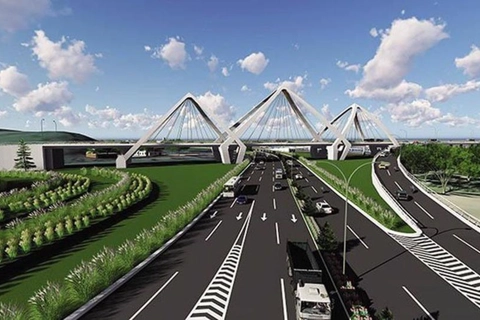
Once completed, Ring Road No.4 will create a new development space for Hanoi, the Capital Region, and the Northern Key Economic zone.
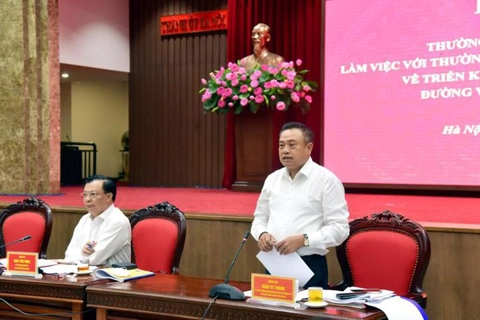
Secretary of the Hanoi Party Committee Dinh Tien Dung has required local authorities to push the construction of Ring Road No.4, which connects Hanoi with neighboring provinces, and further support people during the relocation to ensure the smooth progress of land clearance.
Dung, who also serves as the Head of the Steering Committee on the construction of the Ring Road No.4 - Capital Zone, gave the requirement while checking the project’s site clearance in the districts of Dan Phuong and Hoai Duc on February 16.
Given the people's agreement and excitement about the project, Dung emphasized that the city's responsibility is even greater and expected the authorities to utilize all favorable policies related to the relocation of graves and resettlement to maintain public consensus over the policies of the Central Government and the city.
“The priority is for affected households to quickly settle down in new places,” he said.
| Hanoi Party Chief Dinh Tien Dung at Dan Phuong District. Photos: Thanh Hai/The Hanoi Times |
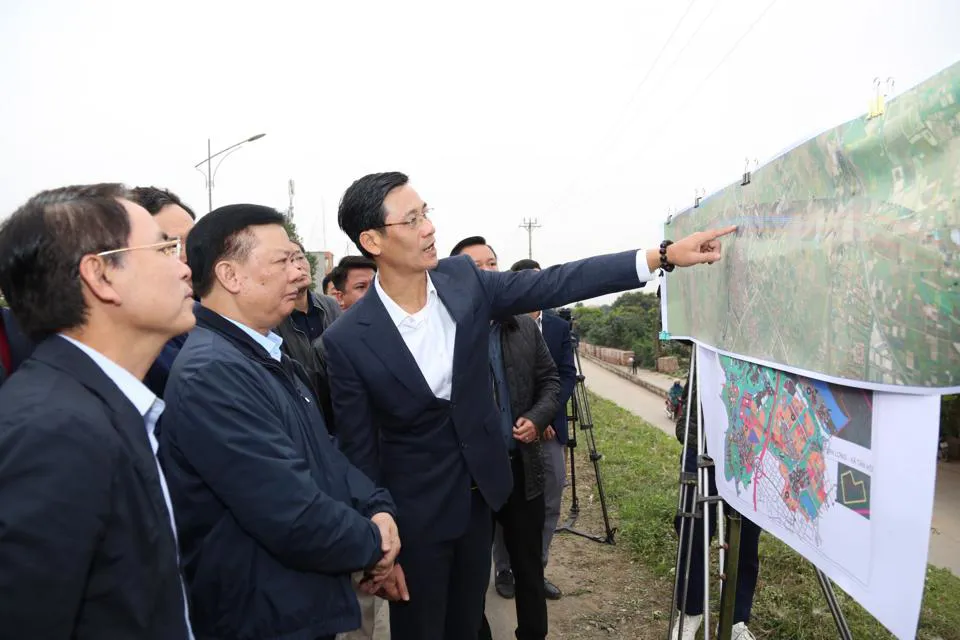
Dan Phuong, one of the six Hanoi districts in the project area, will requisition 74.8 hectares with 1,789 households.
So far, some 19 hectares have been requisitioned, or 25.5% of the target, with a compensation value of VND218.1 billion ($9.17 million).
Currently, the district is prioritizing the implementation of four projects, of which the one of highest priority is the expansion of the public cemetery, which will accommodate graves relocated from areas under the project.
The district aims to hand over 70% of the land by June 2023, and 100% of the land area by the end of December 2023.
In Hoai Duc district, the Department of Natural Resources and Environment has handed over 239.63 hectares from 12 communes, while the authorities are still in negotiation with 37 households for an area of 1.1 hectares and an estimated fund of VND11.3 billion ($475,200).
Regarding the relocation of graves, the district approved compensation for 2,152 households worth VND23.15 billion ($973,500). As of now, 1,543 out of 2,152 households have received compensation and support totaling VND15.78 billion ($663,585), and 1,393 graves have been moved.
| The Party chief discusses the site clearance work with a local. |
.jpeg)
During his working visit to Dan Phuong and Hoai Duc districts, Dung expressed his delight at the public’s support of the Central Government and the city's implementation of the Ring Road No.4 project.
Dung expected the project, once completed, would not only create a new development space for Hanoi but also for the Capital Region and the Northern Key Economic zone.
Furthermore, the construction of Ring Road No.4 will open up more development opportunities for the capital and enable the relocation of people to outer areas, solving pressing issues in the inner city such as flooding, traffic congestion, and environmental pollution, he added.
According to Dung, this project would also help facilitate the relocation of contaminated facilities, universities, and hospitals out of the metropolitan areas to make more land available for public and healthcare centers in the city.
The preservation of historical and cultural relics, particularly in the inner city, will also be prioritized, Dung said. "The key to preserving the cultural and historical relics of Hanoi and the inner city is to ensure balanced development among inner-city, suburban, and remote districts, in line with Hanoi's development policy,” he continued.
Dung called for leaders of the Dan Phuong and Hoai Duc districts to take a high sense of responsibility in site clearance work to ensure progress, quality, and efficiency.
“The Ring Road No.4 is considered a national strategic project of utmost importance and any mistakes could undermine the trust of the people and leadership,” he stated.
The Ring Road No.4 is a highway construction project that will span 112.8 kilometers, covering an area of 1,341 hectares, and passes through Hanoi, Hung Yen, and Bac Ninh cities. The project, estimated to cost approximately VND86 trillion (US$3.64 billion), will be divided into seven components, with three components on compensating and providing support to households that will be relocated, three on constructing urban roads using public funds, and one on constructing an expressway through a public-private partnership. Once completed and open to traffic in early 2027, it is expected to improve connectivity between Hanoi and other northern provinces, supporting the socio-economic development of the entire northern region, with Hanoi being the main driver of growth. |