Hanoi plans to buyback 450,000 gas motorbikes in downtown areas
The city would cover nearly all costs related to the transition, including registration and license plate fees for new electric vehicles.
THE HANOI TIMES — Hanoi is developing a mechanism to assist residents in the Belt Road 1 area with switching from gasoline-powered motorbikes to electric vehicles, as the city plans to ban an estimated 450,000 fossil-fuel motorbikes from the zone starting July 2026.

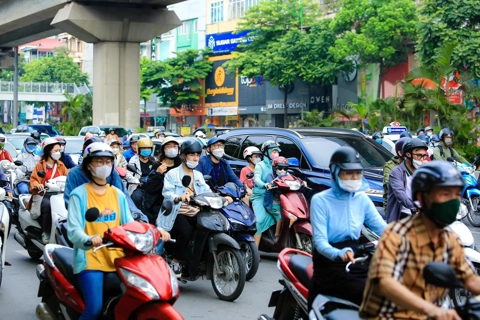
The motorbike is the most common mode of transportation in Vietnam. Photo: Hai Linh/The Hanoi Times
Vice Chairman of the Hanoi People’s Committee Duong Duc Tuan spoke to local media on July 14 about the potential move, which is part of the city’s broader effort to implement the Prime Minister’s Directive No. 20 on addressing air pollution.
Tuan stated that the support policy will be based on a thorough analysis of different user groups and vehicle types. The incentive policy will be reported to the municipal Party Committee before it is submitted to the People's Council for approval.
“The city aims to cover nearly all costs related to the transition, including registration and license plate fees for new electric vehicles,” said Tuan.
Alongside the plan for personal vehicles to transition to electric, Hanoi is investing in green public transportation for people living in the affected areas.
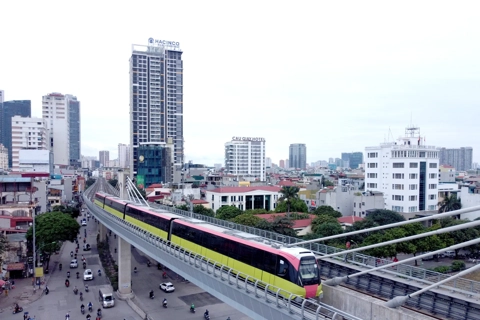
The city plans to expand its fleet of eight- to 12-seat electric buses and four-seat electric vehicles operating inside Ring Road 1. At the same time, urban railway line projects will be accelerated. The Cat Linh–Ha Dong and Nhon–Hanoi Station lines are already operating in the area, and the Ho Tay–Hoa Lac and Nam Thang Long–Tran Hung Dao lines are next.
Hanoi will also update its urban planning to include charging stations for electric cars and motorbikes.
"Charging stations will be set up in parking lots and residential buildings," said Tuan.
The city official confirmed that Hanoi will provide maximum support to those affected, ensuring the smoothest possible transition for residents of Ring Road 1 and frequent travelers to the area.
On July 14, Hanoi established an interagency task force to counsel the People's Committee on green transportation plans and to expand the city’s electric vehicle charging network. According to Directive No. 20, issued on July 12, Prime Minister Pham Minh Chinh requested that Hanoi devise a roadmap to ban fossil fuel-powered motorbikes from the city center by mid-2026 and expand low-emission zones to cover the entire city by 2030.
Specifically, gasoline-powered motorbikes will be banned from operating within Belt Road 1 starting July 1, 2026. Starting January 1, 2028, the restriction will extend to Ring Road 2 and include a ban on motorbikes and private gasoline-powered cars. By 2030, the restricted area will expand to Ring Road 3.
The directive requires Hanoi to formulate policies that support the public in switching to cleaner vehicles and encourage the use of public transportation by September 30. Concurrently, the city must introduce policies to support businesses involved in manufacturing and assembling clean-energy vehicles.
Starting in the third quarter of 2025, Hanoi will study increasing registration, license plate, and parking service fees for fossil fuel–powered vehicles operating in the city center.
Currently, Hanoi has more than 9.2 million vehicles. Of these, approximately 8 million are registered with the city authorities, including 1.1 million cars and 6.9 million motorbikes, as well as around 1.2 million vehicles from other provinces.
|
Ring Road No. 1 is 15 kilometers long and is the innermost of Hanoi's three ring roads, encircling the city center, along Kim Lien, Dai Co Viet, Hoang Cau, and O Cho Dua. |