Hanoi pushes for completion of ring road networks
Although considerable resources have been invested, only 132 km (46.33%) of the planned 285 km ring roads have been constructed.
For many years, Hanoi has devoted significant resources to gradually completing and fully connecting its ring road system, but much remains to be done.
| The elevated part of the Ring Road No.2 in Hanoi. Photo: Pham Hung/The Hanoi Times |
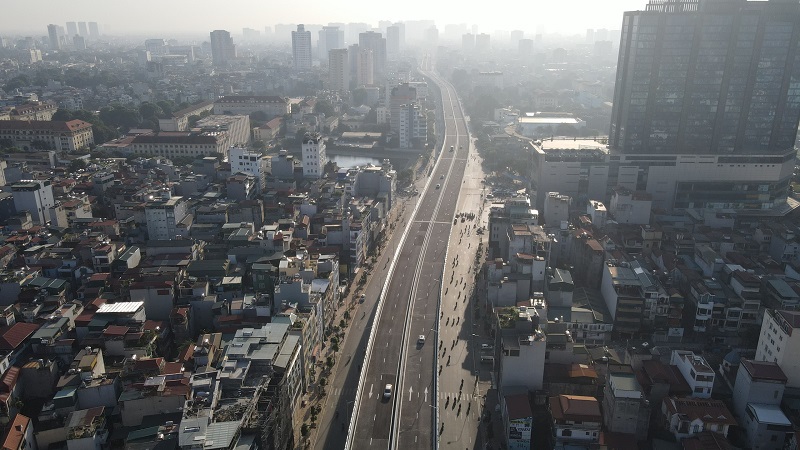
Despite significant investment over the years, Hanoi's ring road network remains incomplete, with only 46% finished according to the plan. In response, the city plans to phase investments to ensure feasibility. Contractors have been required to be prepared with resources and manpower to accelerate the progress of eligible projects.
One year after the start of work, Hanoi's Ring Road 4 project has seen considerable progress. Nguyen Chi Cuong, Director of Hanoi's Transport Construction Investment Project Management Board, stated that this national key project has been actively pursued by all stakeholders since construction began in June 2023.
“The project is currently on track,” said Cuong.
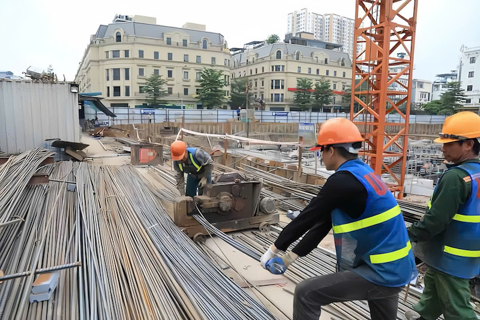
To build the service roads to the Ring Road in Hanoi, contractors have mobilized around 600 engineers and workers, along with hundreds of machines, across 32 construction sites. The 13 km section north of the Red River is expected to be completed by the end of 2024, while the 19 km section in Hoai Duc District is scheduled to be finished by mid-2025. Work on other sections is progressing at a similar pace. For Ring Road 4 itself, built under the PPP (public-private partnership), steps are being taken to complete investment procedures and select an investor by the end of Q3 2024.
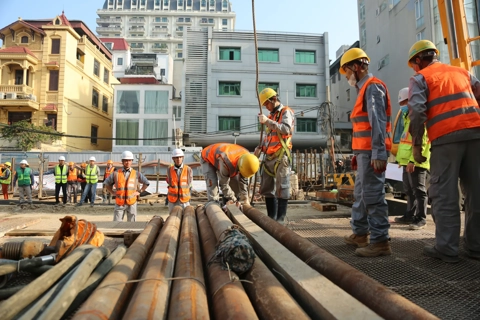
At the site of Vinaconex's 23-kilometer Ring Road 4 service road through Dan Phuong and Hoai Duc districts, project manager Nguyen Hoang Hai reported that taking advantage of favorable weather conditions, 23 construction teams with 140 machines and nearly 340 workers are working simultaneously on roads and bridges to speed up the project. In early October 2022, Hanoi began construction of an underpass at the Kim Dong - Giai Phong intersection on Ring Road 2.5 in Hoang Mai District. After over a year and a half, significant portions of this 460-meter-long, four-lane underpass have been completed. Key works such as the Dam Hong side tunnel and the Kim Dong road extension are well underway.
Ho Duc Phuc, Director of the Kim Dong Underpass Project for Cienco4, indicated that the project is divided into three zones and has reached over 45% completion. All resources are being mobilized to meet the project deadline.
The Ring Road 1 project between Hoang Cau and Voi Phuc, which stretches 2,274 meters through the Ba Dinh and Dong Da districts, has been delayed due to land clearance issues. Vice Director of the Hanoi Project Management Unit of Civil and Industrial Projects Do Viet Hung said the project is expected to finish in 2024, but delays in land clearance have extended the timeline to Q1 2025.
“Efforts are underway to accelerate land clearance and select construction contractors,” Hung added.
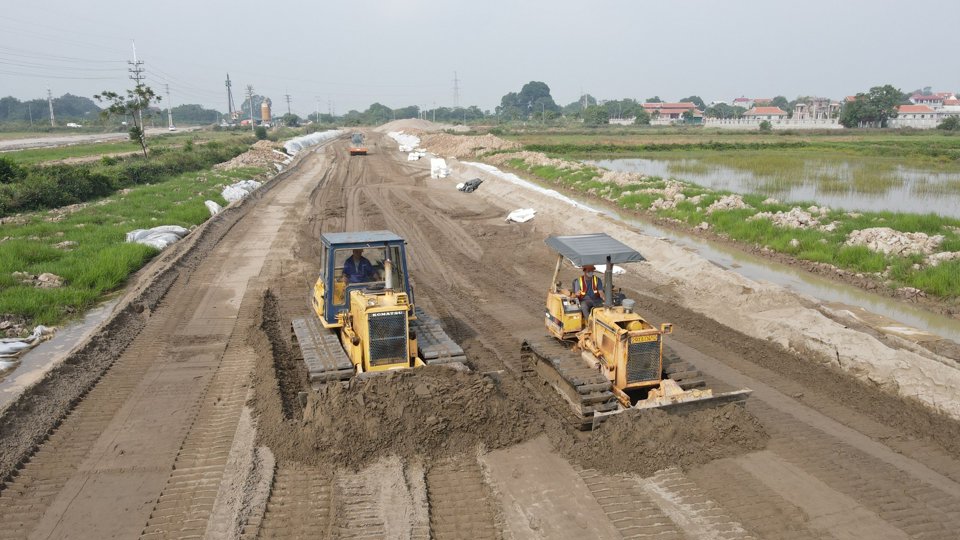
Specific challenges include the significant investment required, particularly for the 83.26 km currently being planned for five sections of Ring Road 3.5 and Ring Road 4 in Hanoi, which will require approximately VND53.5 trillion (US$2.1 billion).
Vice Director of Hanoi Transport Department Tran Huu Bao pointed out that land clearance and resettlement in densely populated areas also pose significant challenges, affecting project schedules and social stability.
"This remains a major factor in delaying the construction of the ring road network, which has reached only 46.33% completion so far," said Bao.
According to Bao, to address these challenges and complete the ring road system, Hanoi's Department of Transport has proposed phased investments for the remaining segments. For Ring Road 1's Hoang Cau - Voi Phuc segment, the plan is to first complete key intersections by 2025, with the remaining components to follow in subsequent phases. For Ring Road 2, the department proposes completing the Nga Tu So - Cau Giay segment, including the elevated road, by 2026-2030. For the remaining 14 km of Ring Road 3, the city plans to include this segment in the 2021-2025 medium-term public investment plan, eventually completing the entire ring road network of Hanoi, he noted.