Hanoi
Hanoi: Striving for development
In the recent meeting with leaders of the Hanoi Party Committee, Hanoi’s Council and Hanoi People’s Committee, the Prime Minister Nguyen Xuan Phuc stressed: “Hanoi still has high potential for development from land resources, which is an important source for Hanoi to carry out projects, especially transport infrastructure projects”.
According to calculation, in order to improve the transport infrastructure foundation for period 2016 – 2020, with vision to 2030, Hanoi would need approx. 200 trillion VND, not to mention 40 billion USD necessary to invest in urban railway. However, the state budget can only meet 20% the financial demands for infrastructure development. The transport infrastructure foundation is not simply just roads and streets. As such, the transport infrastructure foundation of Hanoi includes ring roads, inter-provincial roads and the center roads; major transport hub of the static transport network and urban railway. It is called the transport infrastructure foundation as its role is to be the main frame of the whole Hanoi transport infrastructure.

Such as the ring roads No. 1; 2; 2.5; 3; 3.5 4 and 5 are considered the essential parts, and meet the transport demand of not only Hanoi but also other provinces going through Hanoi to other destinations. Or 4 inter – provincial bus stations waiting to be constructed such as Yen So, Co Bi, Son Tay and Dong Anh; 6 underground parking lots (in the Ring road No. 3) along with other kinds of parking lots under the static transport network. However, these are seen as the receptive components, which coordinates a large part of movements going in and out of the city. Urban railway is also considered as a component of the transport infrastructure foundation, due to its difference to bus. As such, the urban railway has its own infrastructure system; the amount of transport demand for each route is significant higher than bus, which is the direct supply and coordinate the operational frequency of other public transport modes.
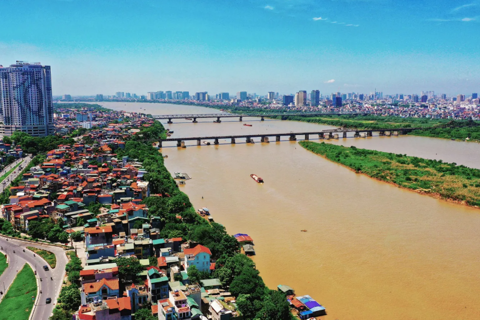
At present, the priority is to specify the Hanoi master plan, which is approved by the Prime Minister; update and systemize the list of projects under the mid term investment plan in period 2016 – 2020. With regard to road transport, Hanoi is striving to complete ring roads no. 1, 2, 2.5, 3 and 3.5, and constructing some sections of the ring road no. 4. The city will focus on investing bridges over Red and Duong river including: Tran Hung Dao, Thuong Cat, Tu Lien, Vinh Tuy phase 2, Giang Bien, Duong 2, among others.
In this context, Hanoi has decided to get breakthrough through public-private partnership in form of build – transfer (BT). As such, transportation in Hanoi will not be charged for additional fee, with Hanoi going toward the solution of exchange land plot for infrastructure. This will bring massive benefits to the city and citizens. Firstly, Hanoi can mobilize additional financial resources to invest in infrastructure. Secondly, land plots in exchange will turn into residential areas, which for one side can reduce the population density in urban area and create, on the other side to create new image for the city; Thirdly, citizens do not have to pay additional fees but still can experience modern transport infrastructure.
With the statement that Hanoi can still develop with its internal force, and the city will take full advantage of it, the Prime Minister said the government will create favorable conditions with regard to mechanism, decentralization and authorization for Hanoi to be active in carrying out projects. However, in order to realize this plan, it requires the investors to be capable in financial and experience terms.
Such as the ring roads No. 1; 2; 2.5; 3; 3.5 4 and 5 are considered the essential parts, and meet the transport demand of not only Hanoi but also other provinces going through Hanoi to other destinations. Or 4 inter – provincial bus stations waiting to be constructed such as Yen So, Co Bi, Son Tay and Dong Anh; 6 underground parking lots (in the Ring road No. 3) along with other kinds of parking lots under the static transport network. However, these are seen as the receptive components, which coordinates a large part of movements going in and out of the city. Urban railway is also considered as a component of the transport infrastructure foundation, due to its difference to bus. As such, the urban railway has its own infrastructure system; the amount of transport demand for each route is significant higher than bus, which is the direct supply and coordinate the operational frequency of other public transport modes.
At present, the priority is to specify the Hanoi master plan, which is approved by the Prime Minister; update and systemize the list of projects under the mid term investment plan in period 2016 – 2020. With regard to road transport, Hanoi is striving to complete ring roads no. 1, 2, 2.5, 3 and 3.5, and constructing some sections of the ring road no. 4. The city will focus on investing bridges over Red and Duong river including: Tran Hung Dao, Thuong Cat, Tu Lien, Vinh Tuy phase 2, Giang Bien, Duong 2, among others.
In this context, Hanoi has decided to get breakthrough through public-private partnership in form of build – transfer (BT). As such, transportation in Hanoi will not be charged for additional fee, with Hanoi going toward the solution of exchange land plot for infrastructure. This will bring massive benefits to the city and citizens. Firstly, Hanoi can mobilize additional financial resources to invest in infrastructure. Secondly, land plots in exchange will turn into residential areas, which for one side can reduce the population density in urban area and create, on the other side to create new image for the city; Thirdly, citizens do not have to pay additional fees but still can experience modern transport infrastructure.
With the statement that Hanoi can still develop with its internal force, and the city will take full advantage of it, the Prime Minister said the government will create favorable conditions with regard to mechanism, decentralization and authorization for Hanoi to be active in carrying out projects. However, in order to realize this plan, it requires the investors to be capable in financial and experience terms.