Hanoi to build new 8-lane road connecting Ring road 4
This project aims to enhance connectivity and support the city’s growing transportation needs, aligning with its approved urban development plans.
THE HANOI TIMES — Hanoi is set to construct a new 6.5-kilometer, 8-lane road linking Route 70 to Ring road 4, as part of efforts to strengthen urban connectivity and reduce traffic congestion.
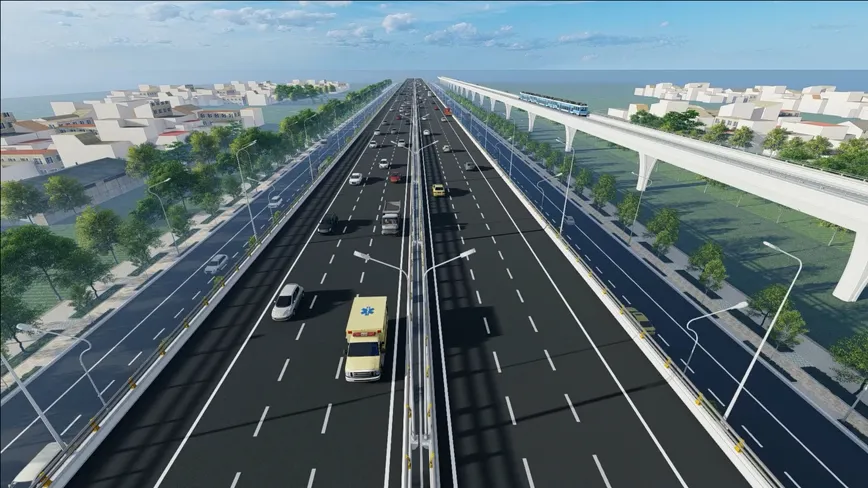
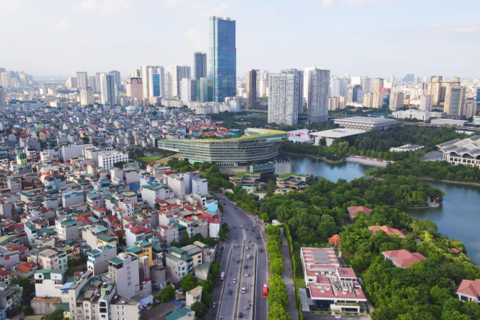
The road features 8 traffic lanes spanning 32m, flanked by 15-meter-wide sidewalks on both sides. Illustration: Pham Cong/The Hanoi Times
The project, announced by the Hanoi Institute of Construction Planning on August 5, will pass through Xuan Phuong and Tay Tuu wards, along with O Dien and Hoai Duc communes.
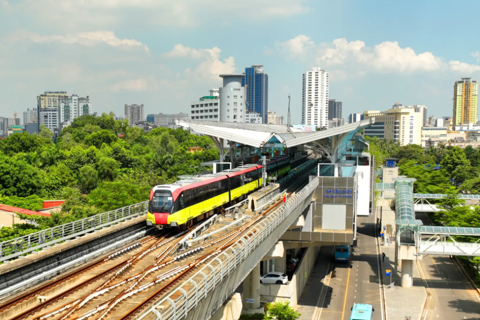
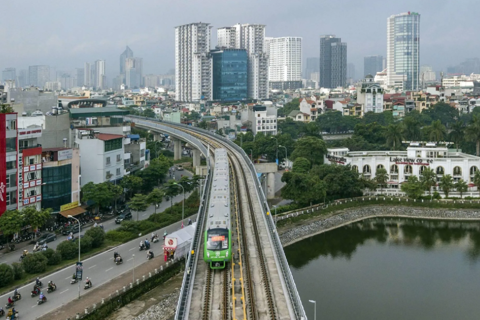
Starting at the intersection with the planned Route 70 and ending at Ring road 4, the road is designed as a major urban arterial road. With a standard width of 50m, it will feature eight traffic lanes spanning 32m, flanked by 7.5-meter-wide sidewalks on both sides and a 3-meter central median reserved for the elevated urban railway Line 3 and its stations.
The project features a notable 0.2-kilometer section near the Hanoi University of Industry, where the road will widen to 66.5–68.5m to include an urban railway station in the central median, with pedestrian stairways on the northern sidewalk.
To ensure smooth traffic flow, the Hanoi People’s Committee has planned six grade-separated intersections, including overpasses or underpasses, at key junctions with Route 70, Ring road 3.5 (from Thuong Cat Bridge to Thang Long Boulevard), Ring road 4, and three regional roads connecting the S1, S2, and S3 urban zones. Other intersections with existing or planned roads will be at-grade, with their boundaries defined during detailed planning or investment stages.
The project aligns with Hanoi’s infrastructure vision, including the 113.7-kilometer expressway spanning Hanoi (57km), Hung Yen (19km), and Bac Ninh (27km), with a 9.7-kilometer link to Noi Bai–Ha Long Expressway. Designed for speeds up to 100 km/h, this expressway will feature 6 lanes, parallel urban roads, green corridors, and provisions for a future ring railway.
With a preliminary investment of VND85.8 trillion (US$3.27 billion), it is divided into seven independent components, three of which are managed by Hanoi authorities, covering compensation, resettlement, urban road construction, and the expressway itself under a public-private partnership model.
The project marks a significant step in Hanoi’s efforts to modernize its transportation network, promising improved accessibility and economic growth for the city’s western region.