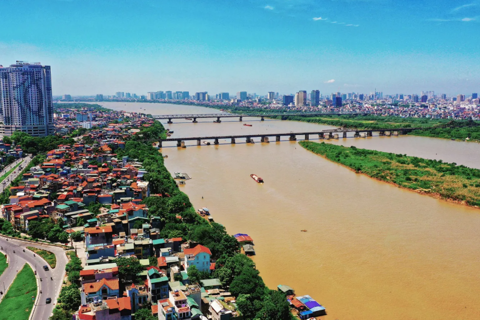
Japan’s JEBO apologizes for misunderstanding Hanoi mayor’s statement
JEBO said they would like to send their sincerest apology to the Hanoi mayor.
The Japan Environment and Business Organization (JEBO) has apologized for not having understood Hanoi's mayor Nguyen Duc Chung’s statement as controversy has arisen as the Japanese entity wants to win a project to clean up the polluted To Lich River in the city.
JEBO said in a statement on December 12 that after reviewing an official letter from the Hanoi government in May 2019 and the entire pilot river clean-up process, the organization admitted that the letter did not grant JEBO the required permission.
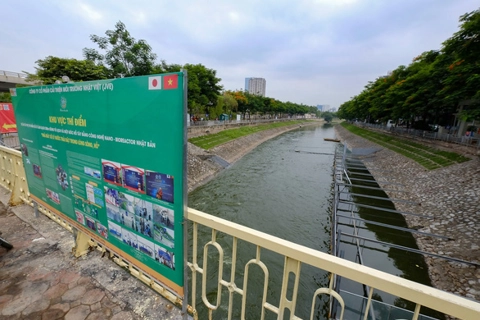
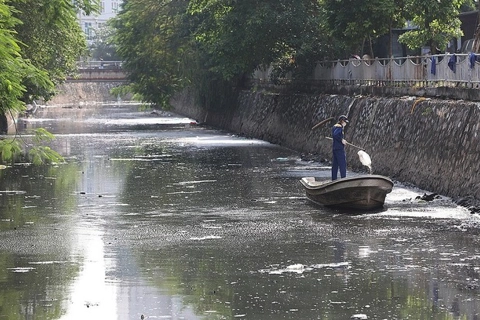
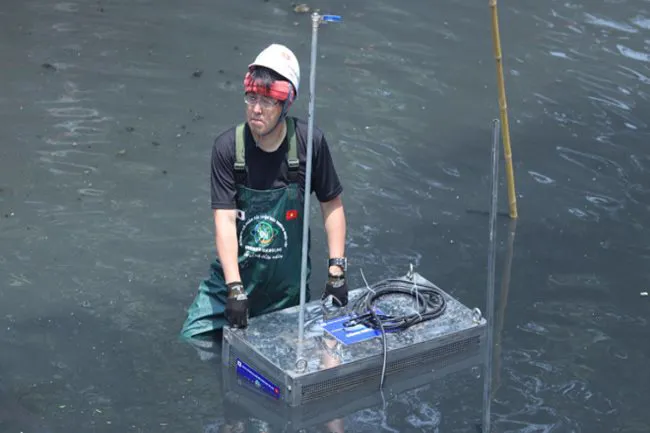
| A JEBO’s expert installs equipment to clean up the heavily polluted To Lich river in Hanoi in May 2019. Photo: TNO |
The letter merely “agrees the collaboration of the Japanese group of experts (referring to JEBO) with Japan-Vietnam Environmental Improvement Company (JVE)” to pilot the cleanup.
The letter was delivered following the April 26 meeting between the Hanoi government, JEBO and JVE on JEBO’s proposal to fund the clean-up of a section of the To Lich river and a corner of West Lake, the largest lake in the capital city.
The letter stated feedback from Hanoi’s Vice Chairman Nguyen The Hung, who had attended the meeting.
JEBO also stated its previous press release, which rejected the Hanoi mayor’s statement, was inappropriate.
“Our press release, which misinterprets the Hanoi mayor’s statement, has raised public concern in Vietnam, so we would like to send our sincerest apology to Mayor Chung and hope that he will forgive us,” said JEBO.
Besides, on November 5, the Hanoi government requested JEBO to provide documents on technical standards related to the nanotechnology, technology certificate by the Japanese government or a competent authority, records of works processed by nanotechnology in Japan and other countries, among others.
The representative of the Hanoi Department of Construction said that until December 9, after more than one month, JEBO had not provided the department with any documents on its nano-bioreactor technology.
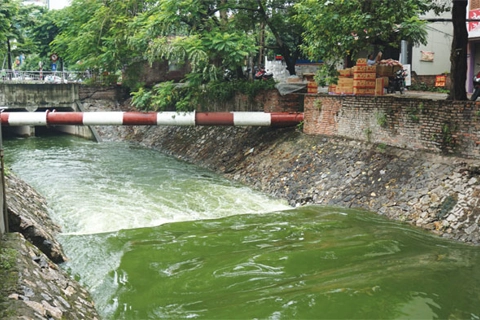
The To Lich river runs 14 kilometers through the downtown districts of Thanh Xuan, Hoang Mai and Thanh Tri and is infamous for its stench and brackish water.
The pollution was attributable to the 150,000 cubic meters of raw sewage released daily into the river, according to statistics by the Hanoi Department of Environment and Natural Resources.
The municipal government has attempted to clean the river many times over the last decade but no concrete projects have been put forth.
Apart from the Japanese project using nano-bioreactor technology to remove contaminants, Hanoi authorities were also working on two other solutions to clean the river.
One was to build a system to collect the sewage which would then be transferred to the Yen Xa wastewater treatment plant. Construction of the system, however, has lagged behind schedule and won't be ready until 2021.