New two-tier local government drives Vietnam’s growth
Vietnam is set to adopt a new two-tier local government starting July 1, 2025, following constitutional and administrative reforms.
THE HANOI TIMES — "The two-tier local government will boost regional socioeconomic development," said Deputy Minister of Home Affairs Truong Hai Long.

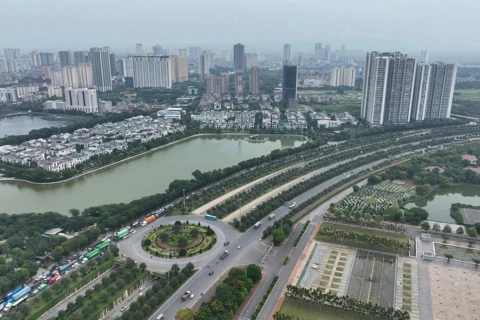
The headquarters of the Party Committee, the People's Council, the People's Committee and other socio-political organizations in Gia Lam Commune. Photo: Kinh te & Do thi
He made this statement at an international press conference on June 17 regarding recent constitutional amendments that will take effect on July 1 onwards, regulating that provinces and centrally-governed cities will operate under a new two-tier local government.
Long said that consolidating provincial and communal administrative units will create opportunities for restructuring development spaces, as the number of subnational administrative units will decrease from 63 to 34, while commune-level governments will be solidified.
He added that a more streamlined government system will help save public spending and improve efficiency and effectiveness.
"A larger province means more room for economic growth, regional investment linkages, and balanced development across different regions," Long said.
"With the two-tier local government, the government will be in closer contact with the people, improving the quality of public services for citizens and businesses."
The Deputy Minister of Home Affairs also noted that implementing the two-tier government system will accelerate Vietnam's digital transformation and the application of science and technology in public administration.
According to Ho Sy Hung, Deputy Minister of Finance, the government has reviewed 5,000 legal documents, identified over 6,700 functions of all levels of administration, and precisely defined approximately 2,700 core responsibilities of central and local authorities.
Of those, 1,470 will be delegated to local governments, and an additional 1,200 will be distributed between the provincial and commune levels. Thus far, the government has issued 28 decrees to specify these delineations of authority.
Hung assured that these changes would not negatively impact the investment and business environment.
“This reorganization will create a broader space for economic and social development and simplify administrative procedures by delegating more authority to direct service providers,” he said.
The reform aims to cut at least 30% of administrative procedures, saving recipients’ time and compliance costs.
According to Hung, the policies to attract foreign investment will not be affected by the new two-tier government structure.
Regarding personnel matters, Deputy Minister of Home Affairs Long said that the rollout of the new system had been carefully coordinated at all levels of the political system, from the central to the local level.
He said that human resources planning has been designed to ensure that the right people are assigned to the right jobs, with well-defined roles and responsibilities based on professional qualifications, experience, and legal knowledge.
Long added that subnational administrative units have developed training and retraining plans for their civil servants to meet new demands.
Regarding infrastructure, Long said agencies have prepared plans to upgrade office buildings and technological infrastructure to ensure connectivity across all newly established commune-level units. Housing for public officials has also been prioritized so they can focus on their work.
"We are confident that, starting July 1, the new administrative system will operate smoothly," he said.
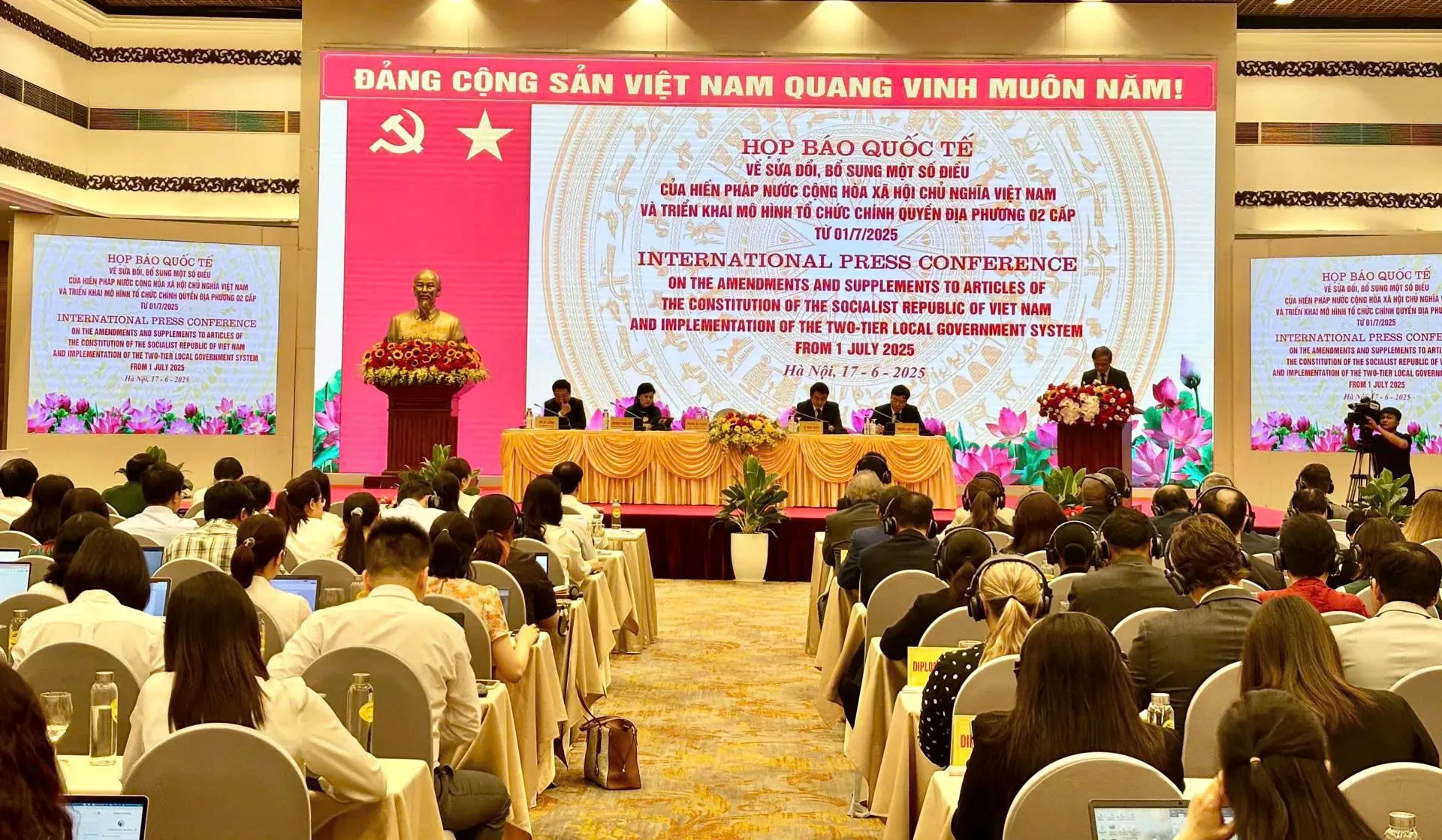
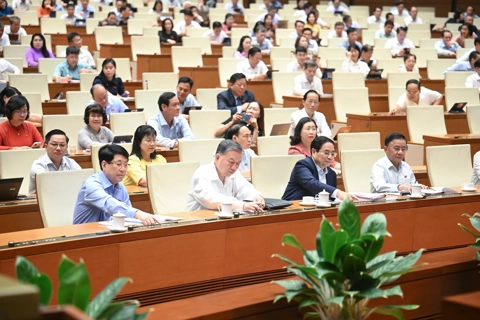
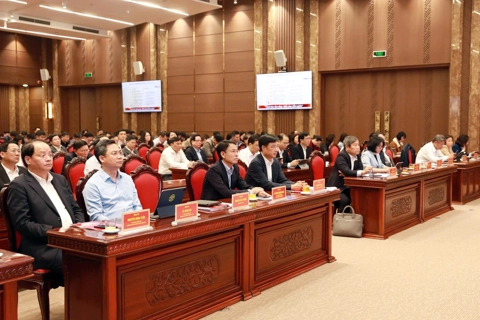
The overview of the international press conference. Photo: Van Ha/The Hanoi Times
On June 16, 2025, the National Assembly adopted a resolution amending several articles of the Constitution and the revised Law on Local Government Organization.
Accordingly, after the restructuring, Vietnam will have 34 subnational administrative units, including six centrally governed cities and 28 provinces.
A total of more than 3,300 commune-level units will be established, including 2,620 communes, nearly 690 wards, and 13 special zones.
According to Pham Tat Thang, Deputy Head of the Central Commission for Propaganda and Mass Mobilization, the adoption of the constitutional amendments and the updated law represents a historic milestone for Vietnam.
"This provides a strong legal foundation for organizing and operating a two-tier local government for the first time in Vietnam," he said.
It enables the implementation of major national policies on development, defense, security, and international integration.
It also marks the beginning of a new era in national development, with a long-term vision for the next 100 years, he stressed.