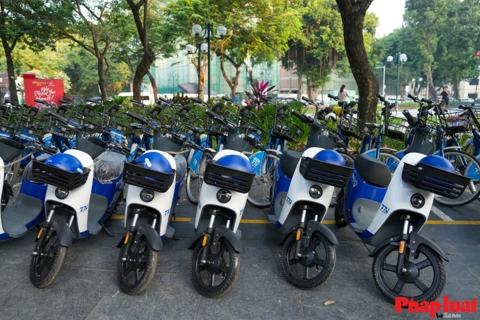
Parking dilemma for Hanoi residents as landlords prohibit electric vehicles over fire risks
Electric vehicle bans in Hanoi apartment buildings highlight fire safety concerns, parking shortages and regulatory gaps amid transport transition.
THE HANOI TIMES — Recent bans on electric vehicle (EV) parking and charging inside apartment buildings and rental properties in Hanoi have put many residents in a difficult position, especially as the city moves closer to restricting gasoline-powered motorbikes.
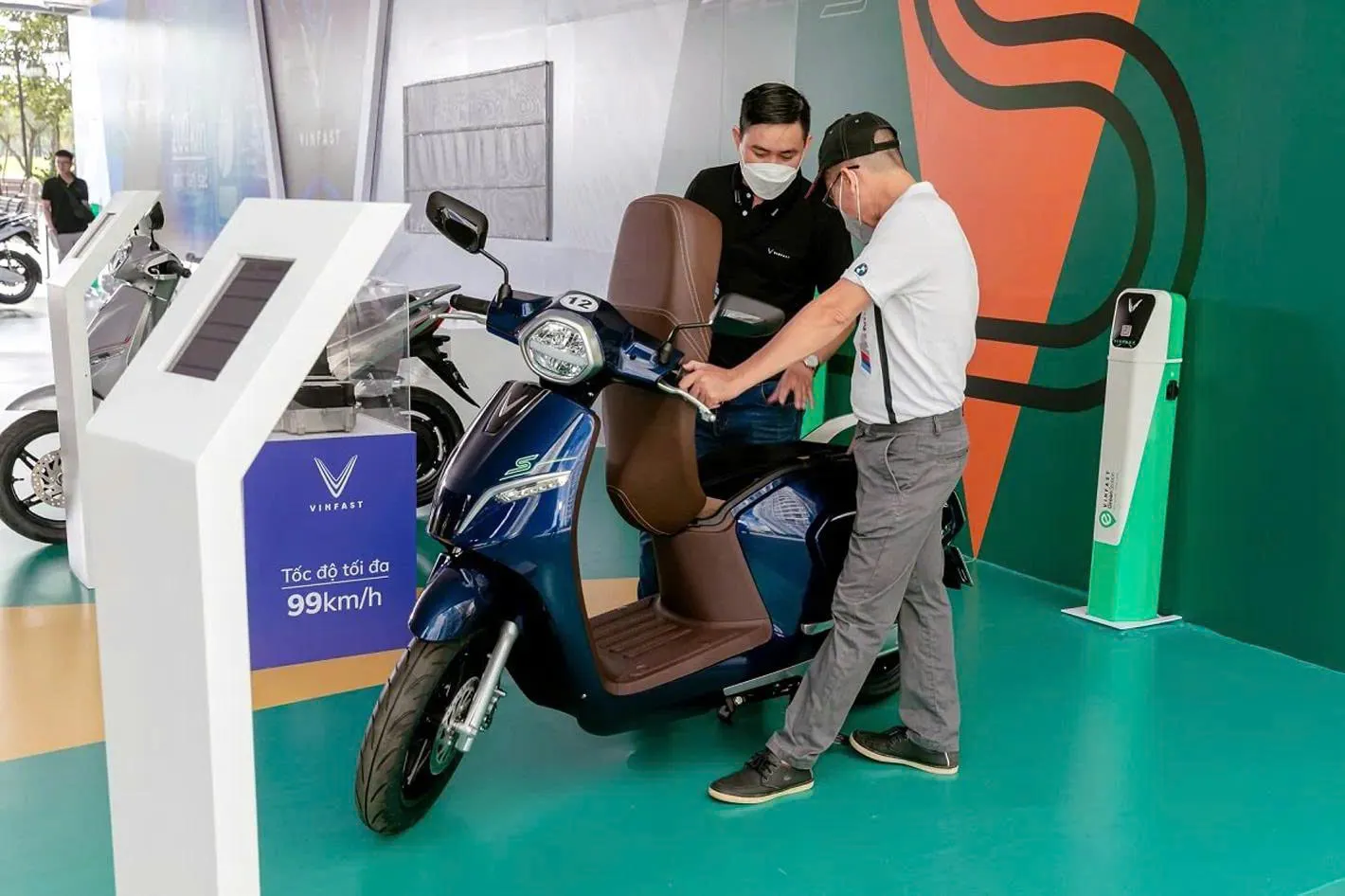
VinFast electric motorbikes on display at an evevnt in Hanoi. Photo: Hoai Nam/The Hanoi Times
Bui Thi Trang, a second-year student at the Diplomatic Academy of Vietnam, rides a gasoline motorbike to school and rents an apartment on Luong The Vinh Street in Tu Liem Ward.
“Where I live, electric vehicles are banned,” Trang said, referring to her landlord’s rule against EV parking.
With gasoline motorbike restrictions expected in Hanoi’s inner low-emission areas, Trang finds daily travel increasingly challenging as most of her routes fall within Ring Road 1.
Switching to an electric bike offers little reassurance. “I don’t know where I would park it when I get home,” she said.
Thu Hien, 21, a student at the University of Social Sciences and Humanities under the Vietnam National University – Hanoi, faces the same problem.
Her rental lies in a narrow alley lined with student apartments, where landlords also prohibit EVs from indoor parking.
Asked about the biggest obstacle if they must switch to electric vehicles, both students pointed to parking access and extra costs.
“Landlords won’t allow electric motorbikes, public parking lacks chargers and if charging services exist, the fees would likely be high,” Trang said.
Landlords cite safety as their main concern. Le Thi Huong, who owns a rental house on Luong The Vinh Street, said fire risks drive her decision to ban EVs indoors.
“I see many fire reports on television and online and that worries me,” Huong said.
From a technical perspective, Pham Minh Tri, a fire protection system design engineer, said EV batteries pose significant fire risks and remain extremely difficult to handle with conventional firefighting methods.
“When an electric vehicle catches fire, firefighters usually can only contain the spread, not fully extinguish it,” Tri told The Hanoi Times.
He added that Vietnam still lacks comprehensive fire safety standards for indoor EV parking and charging, particularly in apartment basements.
According to the Ministry of Construction, EV adoption in Vietnam has accelerated rapidly. The country now has about 6.7 million cars, including roughly 200,000 electric cars, and more than 70 million motorbikes, nearly three million of which are electric and concentrated in major cities.
Financial data from EV manufacturer VinFast showed sales of more than 120,000 electric two-wheelers in Q3/2025, up 535% year on year and 73% from the previous quarter.
During January-September of 2025, the company delivered over 234,500 electric two-wheelers, marking an annual 489% increase.
This rapid growth has intensified pressure on already crowded apartment basements. The challenge extends beyond parking to include charging infrastructure, fire safety and internal traffic organization.
In early December 2025, the management board of CT01 Apartment Building in Long Bien Ward temporarily suspended electric motorbike parking in its basement due to overcrowding.
At HH Linh Dam Apartment Complex in Hoang Liet Ward, the management board announced they would stop accepting new electric motorbikes and bicycles from December 1, 2025 and ban all EV parking in basements from February 1, 2026.
Although Hoang Liet Ward authorities asked the management board to stop refusing EV parking, the decision remained unchanged.
Standards take shape for EVs in apartments
Against this backdrop, the Ministry of Construction has proposed new regulations on EV parking and charging in apartment buildings, placing fire safety at the center.
The draft requires developers to locate EV parking within approved project boundaries and prioritize outdoor or ground-level areas.
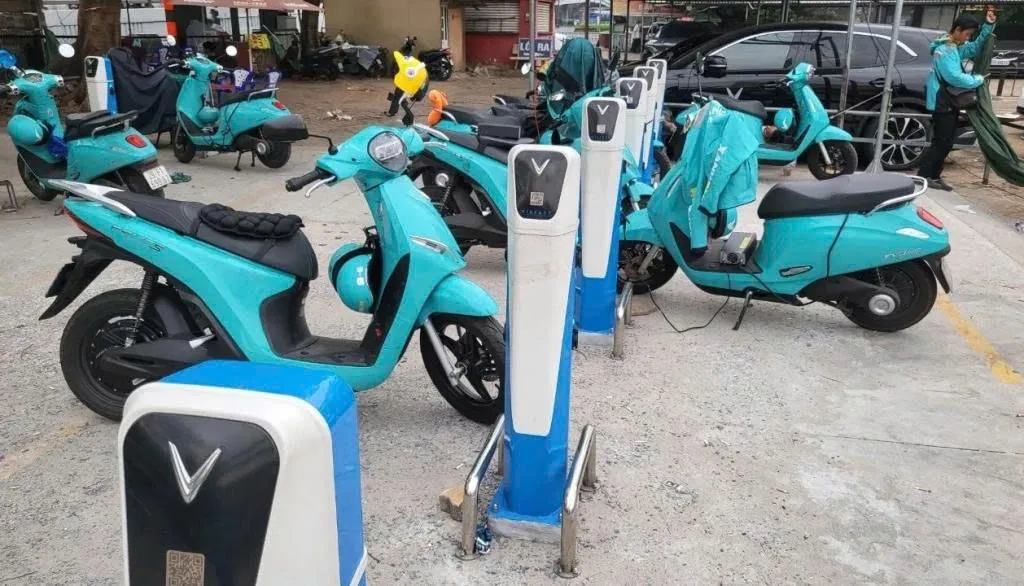
A public electric motorbike charging site. Photo: Nam Trung/The Hanoi Times
Indoor charging would be permitted only on the first basement or semi-basement level, with separate fire compartments, automatic detection and suppression systems, and continuous monitoring.
The proposal also limits charging points and defines compartment sizes to reduce lithium battery fire risks.
Designers must plan EV parking from the earliest design stage, ensure proper ventilation, provide access for rescue forces and maintain clear separation from internal combustion vehicles.
Associate Professor Bui Thi An, Director of the Institute for Natural Resources, Environment and Community Development, said proper EV parking and charging infrastructure remains essential to green growth.
“Residents will hesitate to switch to cleaner vehicles if apartment buildings lack safe and convenient parking and charging,” she told The Hanoi Times.
For new projects, she urged developers to integrate EV infrastructure during planning rather than retrofitting later. For existing buildings, she called for safety assessments to determine whether upgrades remain feasible.
“Charging infrastructure must reflect real demand and resident density,” An said.
She also urged authorities to issue building-specific technical standards, drawing on international experience while adapting them to Vietnam’s fire and electrical safety conditions.
In Tokyo, for example, large new buildings must meet charging and pre-installation standards, including minimum charging ratios, from April 2025, supported by subsidy programs.
Lawyer Truong Thanh Duc, Director of ANVI Law Firm, said many apartment projects underestimated parking demand from the outset, creating long-term constraints.
For existing buildings, he proposed developing public parking facilities with dedicated EV charging, backed by supportive land-use policies.
He also suggested using surplus land from administrative restructuring or factory relocations to create parking areas combined with public spaces.
Architect Dao Ngoc Nghiem, Vice Chairman of the Vietnam Association of Urban Planning and Development, called for national technical regulations to guide developers and support the green transition in housing.
He said new buildings must include separate EV parking and charging zones, while older complexes require additional parking solutions.
On technical safety, engineer Pham Minh Tri stressed that EV parking and charging areas should remain separate from buildings and nearby structures where possible.
When basement placement cannot be avoided, these areas must use fire-resistant walls and doors to ensure isolation during incidents, he said.
Tri also warned that electrical system capacity must match the permitted number of EVs, as overloads pose serious risks to both buildings and residents.
The EV parking challenge has also exposed weaknesses in construction approvals, as many projects failed to account for charging needs at the approval stage.
To encourage early investment, lawyer Hoang Ha from the Ho Chi Minh City Bar Association called for a coordinated policy package.
“Developers need clear economic incentives to address EV infrastructure properly from the design stage,” he said.
He proposed tax incentives for projects meeting charging standards, easier access to state-backed credit, standardized designs and streamlined fire safety procedures without lowering safety requirements.
On land policy, he suggested prioritizing projects that install charging infrastructure early, favoring green-technology investors in public land tenders and classifying charging areas as shared technical infrastructure rather than commercial space.