President Luong Cuong calls for stronger connectivity and resilience among APEC economies
President Luong reaffirmed that as APEC 2027 host, Vietnam will work with partners to deepen regional integration, promote green growth and advance a peaceful, stable and prosperous Asia-Pacific.
THE HANOI TIMES — President Luong Cuong has called on APEC economies to enhance connectivity, boost resilience and support developing members in adapting to external shocks and technological disruptions.
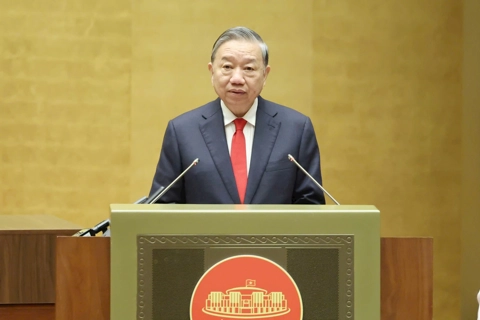
Speaking at the first plenary session of the APEC 2025 Economic Leaders’ Meeting on October 31 in Gyeongju, the Vietnamese President said APEC should focus on strengthening links in supply chains and infrastructure, promoting trade facilitation and empowering the private sector to drive inclusive and sustainable growth.
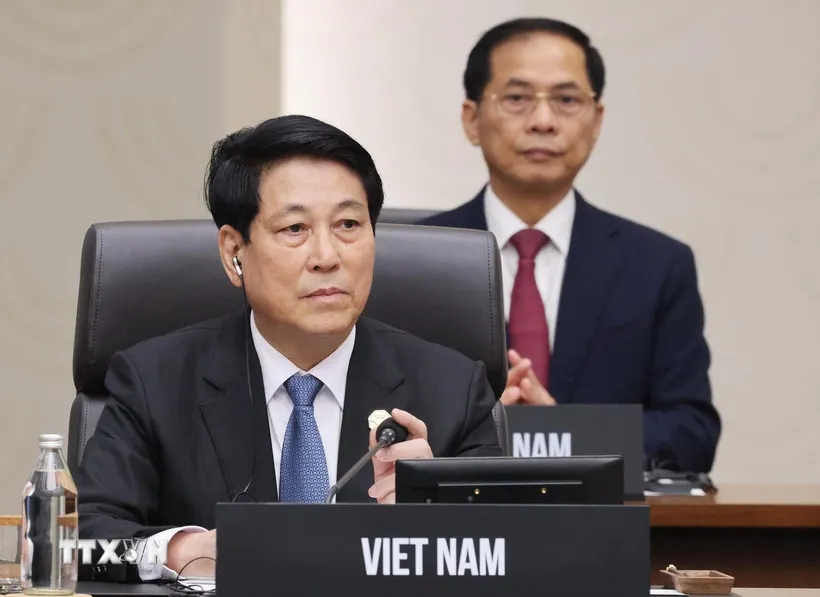
President Luong Cuong attends the 32nd Asia-Pacific Economic Cooperation (APEC) Economic Leaders’ Meeting. Photos: Lam Khanh/VNA
Cuong urged APEC to tackle bottlenecks in supply chains and regional infrastructure by digitizing customs procedures, upgrading transport, logistics and IT networks, harmonizing cross-border data and payment regulations and narrowing the technological gap among member economies.
He called for stronger trade and investment cooperation, including steps to advance the Free Trade Area of the Asia-Pacific (FTAAP) and effectively implement multilateral WTO agreements such as the Trade Facilitation Agreement, while reducing non-tariff barriers.
Cuong said it’s needed to support small and medium-sized enterprises (SMEs) by improving their access to finance, technology and markets and enhancing their governance capacity to compete and grow in the digital era.
“In a time of global macroeconomic uncertainty, solid microeconomic foundations are essential for long-term growth,” he said, adding that the private sector remains a vital engine of APEC’s sustainable development.
Cuong reaffirmed that as the host of APEC 2027, Vietnam will work closely with other economies both within and beyond the forum to strengthen regional integration, foster green growth and build a peaceful, stable and prosperous Asia-Pacific region.
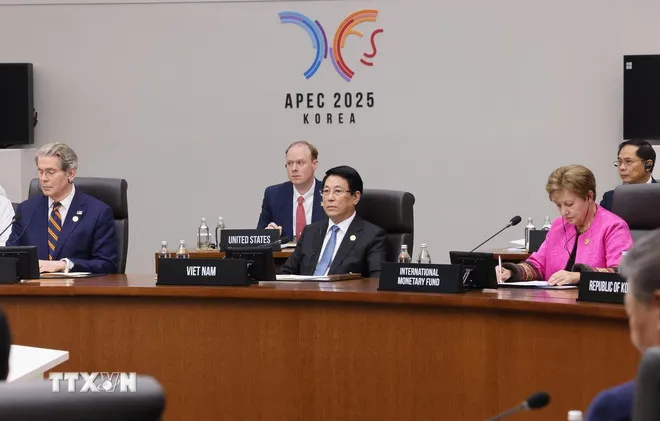
The session’s theme, “Towards a Resilient, Connected, and Dynamic Region,” focused on promoting trade and investment amid global uncertainties and expanding public–private partnerships to unlock the potential of the private sector for inclusive and sustainable development.
Speaking at the opening the meeting, South Korean President Lee Jae Myung highlighted the importance of open and constructive dialogue among leaders to advance common goals of trade, investment, and shared prosperity.
IMF Managing Director Kristalina Georgieva presented a global economic outlook, calling on APEC members to focus on four priorities: ensuring fiscal sustainability, maintaining financial stability, addressing macroeconomic imbalances, and creating a more conducive business environment for private sector growth.
APEC leaders and guests, including the Crown Prince of Abu Dhabi (UAE) and the IMF Managing Director, discussed ways to enhance economic resilience and strengthen regional linkages to tackle shared global challenges.
They agreed to expand public–private partnerships to mobilize resources for green investment, sustainable infrastructure, digital trade and SME competitiveness and emphasized the need to build safe, flexible and sustainable supply chains across the Asia-Pacific.