Raising awareness: addressing traffic safety for Hanoi’s teenagers
Being a teenagers mean you are easily be taunted, and your actions may not end up with good outcomes.
In today's Words on the Street column, The Hanoi Times delves into the rising issue of traffic safety violations among students in the capital. With thousands of cases handled by the city's traffic police, concerns are mounting over underage students operating motorcycles, helmet non-compliance, and the role of parents in ensuring their children's safety on the road.
The article explores the root causes of this issue, the alarming statistics of accidents involving students, and highlights ongoing efforts to foster a culture of responsible driving for Hanoi's youth.
The Traffic Police Department, under the Hanoi Department of Public Security, today (October 14) announced that over 3,000 cases of traffic safety violations involving students have been handled.
Of these, 2,800 were related to students not wearing helmets while riding motorcycles, 540 cases involved underage students riding motorcycles (below the legal age of 18), and 150 cases were due to parents allowing their children to use vehicles despite not meeting the legal requirements.
The Hanoi Traffic Police have also temporarily confiscated more than 1,600 vehicles. The department has issued notices regarding 1,900 student violations to the Hanoi Department of Education and Training.
Clearly, traffic safety issues involving students, particularly in educating them on traffic law compliance, remain a persistent and serious concern every year.
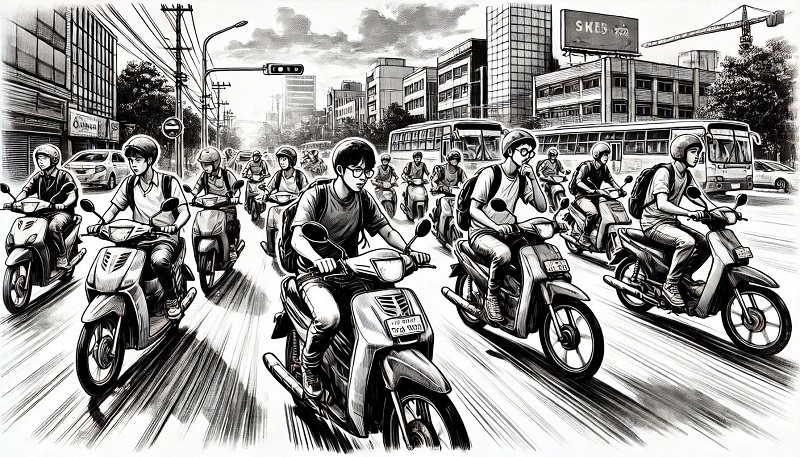
Since the 1990s, students in Hanoi have been riding motorcycles even before reaching the legal driving age of 18. This was during the period when Vietnam's economy began opening up, leading to higher incomes for many in the capital and an improved standard of living. As a result, motorcycles became more affordable and accessible.
With the increasing demands of work, many parents became busier and more lenient, allowing their children to ride motorcycles to school due to the difficulty in coordinating transportation. Moreover, for many students, riding a motorcycle to school became a way to display their "coolness" and assert their social status among peers.
Allowing underage students to operate motorcycles poses significant traffic safety risks. According to statistics from the Traffic Police Department, more than 1,000 students lost their lives in traffic accidents in 2023.
In January-September of 2024, traffic accidents claimed the lives of 780 students and injured 2,000 others. These alarming numbers underscore the need for stricter enforcement to prevent students from driving motorcycles before they are legally allowed.
Young students often lack the maturity and awareness required to obey traffic laws. Impulsive behavior at this age makes them prone to forgetting basic driving principles – principles they should learn and be tested on before taking the wheel.
Additionally, adolescence is a period when they are eager to prove themselves to their friends. It only takes a single taunt or challenge for them to disregard safety rules and endanger not only themselves but also those around them.
Many parents place too much trust in their children's driving skills and traffic knowledge, but in numerous accidents, the students themselves are directly at fault. Common infractions include failing to signal when changing lanes, neglecting to check their surroundings, speeding, reckless driving, and carrying too many passengers.
It is clear that ensuring traffic safety for students is a responsibility that must be shared by the entire society – parents, teachers, schools, and law enforcement alike since merely penalizing students for breaking traffic laws is a short-term measure.
In the long run, we need to implement specific educational models that raise students' awareness, help them understand the hidden dangers, and instill proper driving ethics.
Practical measures
Recently, Ba Dinh District launched the "Safe School Gates" initiative at 15 schools within the district, bringing the total number of participating schools to 30. Additionally, the Hanoi Traffic Police Department, in coordination with district and local authorities, has organized over 90 traffic safety workshops for nearly 90,000 students and 3,900 teachers across the city.
Police have also secured traffic safety pledges from 35,800 middle and high school students, and signed 1,500 agreements with parents, ensuring they do not allow underage children to operate vehicles. The city has also established 15 volunteer teams to guide traffic around school entrances while continuing to maintain the Safe School Gates model across Hanoi. Thousands of helmets and other safety gifts have been distributed to students.
Guaranteeing traffic order and safety for students is considered a top, long-term priority to protect and nurture future generations with a culture of civilized driving. This effort contributes to the sustainable development of the country.
These meaningful actions and programs are expected to shift the perceptions of both parents and students, enhance the quality of education in Hanoi, and create a safe, healthy traffic environment for all.
Hopefully, these initiatives will soon yield positive results, paving the way for a sustainable, modern, and civilized future for Hanoi, a city admired by friends and international visitors alike.