Regional delicacies draw Tet buyers but face hurdles in Hanoi retail networks
Hanoi supermarkets expand Tet offerings of regional specialties, but stable supply, safety compliance and traceability remain critical challenges.
THE HANOI TIMES — The success of regional specialties in Hanoi’s retail market hinges on stable production, strict compliance with food safety and traceability standards and effective coordination between local producers and retail chains.
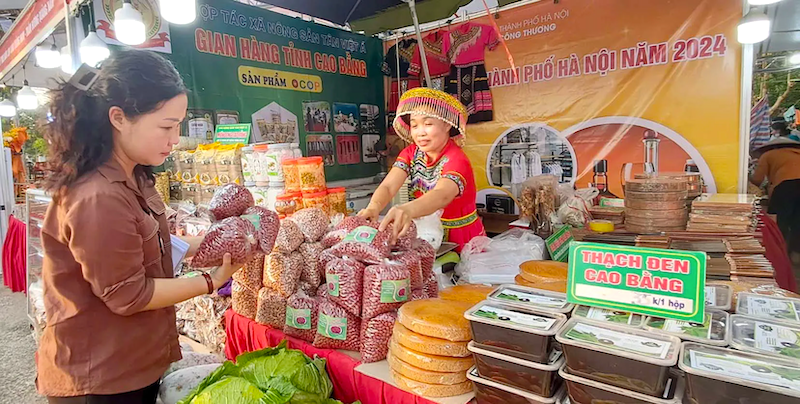
A local consumer shops for regional specialties at a Vietnamese goods fair organized by the Hanoi Department of Industry and Trade. Photo: Hoai Nam/The Hanoi Times
With just over a month to go until Tet, the market for regional delicacies has become increasingly vibrant. Consumers are actively seeking specialty products from different parts of the country, both as gifts and for family celebrations.
According to Le Ha, owner of a regional specialty shop on Nguyen Thi Thap Street in Hanoi’s Khuong Dinh Ward, products such as smoked buffalo meat, wild shiitake mushrooms from Sa Pa, dried bamboo shoots from Tuyen Quang, Vu Dai village braised fish, Quang Ninh squid paste, Thanh Hoa fermented pork rolls and Hue-style fermented shrimp are seeing strong orders.
Beyond traditional markets, Hanoi’s supermarket chains have also stepped up efforts to bring Northern, Central, and Southern specialties to consumers, with a growing focus on organic and value-added products.
Nguyen Thi Kim Dung, Director of Co.opmart Ha Dong, said the chain has prepared a wide range of three-region specialties for Tet, including Vu Dai village carp braised in clay pots, Tra Cuon banh tet from Vinh Long, Danang beef sausage, mac mat pickled bamboo shoots from Lang Son and Nghe An-style pork rolls.
To meet Tet gifting demand, Co.opmart has prepared around 1.2 million Tet gift baskets, many featuring regional specialties such as dried fruits and nutritious nuts, she added.
Similarly, Nguyen Thi Thuy Huong, Northern Region Operations Director of WinCommerce, said WinMart supermarkets have launched curated sets of regional specialties from northern provinces. These include glass noodles, dried rice vermicelli, rice noodles, wood ear mushrooms, and shiitake mushrooms from Son La and Bac Ninh, as well as smoked buffalo and beef from Tuyen Quang.
Despite rising demand and retailer interest, many localities still struggle to bring their specialties into modern retail systems.
Ma Thi Ninh, Director of Yen Duong Cooperative in the northern province of Thai Nguyen, said that although Thai Nguyen’s fragrant pumpkin is a well-known local specialty, supplying supermarkets in large and consistent volumes has proven extremely difficult.
From a management perspective, Vu Hong Son, Director of the Dien Bien Department of Industry and Trade, noted that Dien Bien rice and the locally famous ethnic minority cucumber known as “dua meo” are popular in domestic markets.
However, when Hanoi’s retailers request large-scale supply, local producers often cannot meet volume and consistency requirements. This is a key reason why Dien Bien’s specialties are rarely seen on supermarket shelves in the capital.
Explaining the barriers, Nguyen Thi Thu Hang, Director of Go! Thang Long Supermarket, said one of the main obstacles is that many regional specialties fail to meet strict requirements on food safety standards and traceability.
In addition, producers often underestimate the long-term development potential of their specialty products, resulting in simple packaging, weak branding, and limited coordination to build effective distribution networks.
Tran Thi Phuong Lan, Chairwoman of the Vietnam Retailers’ Association, added that supermarkets require products to have clear origins and trademarks protected by competent authorities.
However, most regional specialties are produced by small, household-based facilities that have not registered brand protection.
Supply is often unstable, and producers’ market access capacity remains limited, she noted.
“This is one of the reasons why many contracts between producers and distributors, even after being signed, have to be canceled due to insufficient supply,” Lan said.
To address these challenges, the Hanoi Department of Industry and Trade has rolled out multiple initiatives to connect supply and demand between provinces and modern retail systems.
According to Nguyen The Hiep, the department’s Deputy Director, trade fairs, agricultural markets, and regional specialty events have increasingly served as bridges for provincial businesses to access modern retail channels.
The state agency has also supported enterprises and cooperatives in applying information technology to production and distribution, including traceability systems, product promotion, and connections through e-commerce platforms.
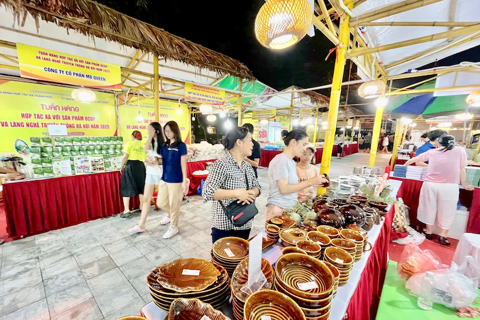
In parallel, Hanoi has organized mobile sales programs, “Vietnamese goods” markets, and a wide range of trade and investment promotion activities across the city.
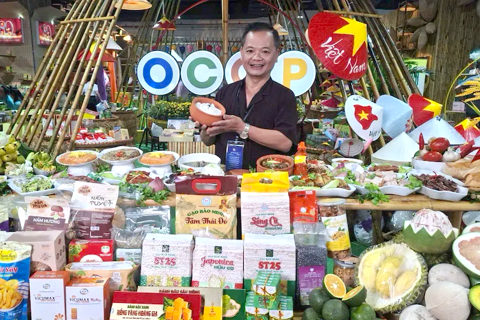
For the 2026 Lunar New Year, the department plans to organize 12 major events, including the Spring Fair 2026, One Commune One Product (OCOP) fairs, and five post-Tet trade fairs, which aim to help businesses expand consumption channels while allowing consumers to access regional specialties that meet quality, origin, and pricing standards.
“Hanoi’s proactive efforts to promote trade and consumption of regional specialties will help change consumer awareness, encouraging greater preference for domestically produced goods. This will create sustainable market outlets for local agricultural and specialty products ,” he said.