Transformation in Hanoi’s Red River neighborhoods expected under two-tier administration
The establishment of a new ward under Hanoi's updated governance model will accelerate the modernization of both banks of the Red River and help redefine the capital's urban identity.
THE HANOI TIMES — Hong Ha Ward officially came into being on July 1, distinguished not just by its size or population but by the history it holds, as for decades, communities along Hanoi's Red River were trapped in urban limbo, governed by a patchwork of jurisdictions and often neglected in terms of investment, infrastructure, and public services.
Now, that changes.
From fragmentation to unity
Hong Ha Ward, formed from the merger of several neighboring wards, covers 16.6 square kilometers, is home to more than 126,000 people, and incorporates areas from the former districts of Hoan Kiem, Ba Dinh, Tay Ho, Hai Ba Trung, and Long Bien, unifying previously separate neighborhoods.
Dr. Dao Ngoc Nghiem, an architect and the former Director of the Hanoi Department of Planning and Architecture, called the creation of Hong Ha Ward a breakthrough. "This is not just a shift in governance," he said. “It is a step toward coherence, one that finally allows us to address the needs of riverfront communities thoroughly.”
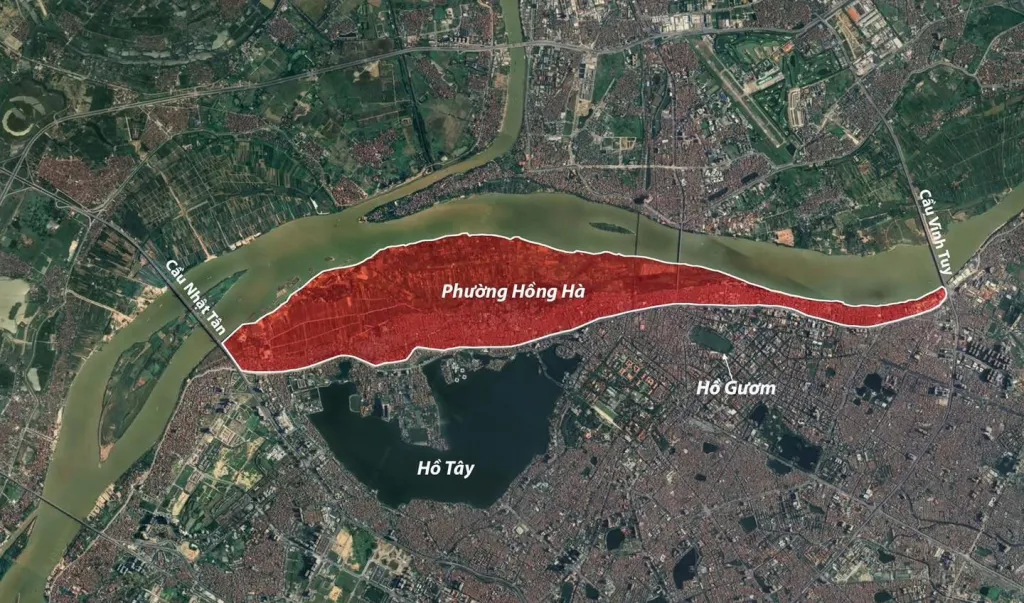
Hong Ha Ward's administrative boundary covers the entire riparian area outside the Red River dyke (red zone). File photo
Previously, planning and investment along the river were hindered by overlapping ward jurisdictions, leaving “a beautiful area left in administrative limbo,” said Nguyen Van Tinh, a lifelong resident near Bo De, where taxpayers lacked even a paved road for years - now there's finally hope for something better.
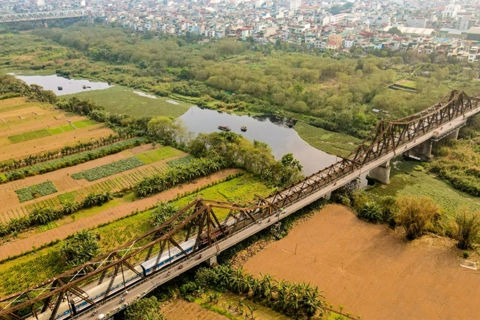
For many residents, the administrative change means more than improved infrastructure. It is a recognition of their presence and value. “My grandchildren might finally have a proper playground, and my daughter can consider opening a shop here without worrying about permit issues,” said Le Thi Hoa, a 67-year-old vendor near Long Bien Bridge. “We’ve waited a long time for this.”
According to the Politburo’s Conclusion No. 80-KL/TW and the Capital Master Plan extending to 2045, Hanoi has been tasked with transforming the Red River corridor into a new axis of development. The ambitious goal is to blend ecological balance, cultural heritage, and urban modernity into a single, livable landscape.
“This is not just about concrete and bridges,” said Professor Hoang Van Cuong, former Vice President of the National Economics University and lead advisor to the planning team. "It's about making the Red River the emotional and functional heart of Hanoi."
The riverbanks are expected to house modern service and commercial hubs, cultural landmarks, and green public spaces. Projects such as the Tu Lien and Tran Hung Dao bridges are not merely transport links; rather, they are considered anchors for economic and social transformation.

The Red River's alluvial islet. Photo: Khanh Huy/The Hanoi Times
Unlock the potential
The Hanoi Red River Subdivision Plan (1:5000 scale), approved in 2022, provides the legal foundation for this transformation. Since then, several riverside neighborhoods have been officially recognized, residents have received long-awaited construction permits, and new roads have begun to take shape beyond the dyke.
Between 2025 and 2030, investments are set to intensify. Hong Ha Ward will be the epicenter of bridge construction, transportation development, landscape regeneration, and cultural revitalization. "The area has always had potential," said architect Nghiem. "Now, we finally have a structure that can unlock it."
The land along the river and its islets comprises nearly 10% of Hanoi’s agricultural land, a valuable asset. Previous plans called for reducing the population from 210,000 to 160,000 to ease pressure on infrastructure. However, the new vision views the riverfront as a driver of growth, not a drain on resources.
New projections estimate an increase in population to 300,000. This will require new housing, services, and public utilities, as well as flood protection and sustainable planning. Hong Ha Ward's streamlined governance will now lead the coordination of these efforts, ensuring safety and livability.
Tran Ngoc Chinh, Architect and President of the Vietnam Urban Planning and Development Association, emphasized the key role of local governance. "When decision-making is more localized, planning becomes more responsive. Hong Ha Ward is an opportunity to demonstrate the potential of local leadership."
Indeed, residents are watching with cautious optimism. For years, their stories were mere footnotes in the city’s grand development narrative. Now, their voices are becoming part of the plan. “We don’t expect miracles,” said Hoa with a weary but hopeful smile. "But at least someone is listening now."
Hong Ha Ward signifies more than an administrative change, but a shift in how Hanoi views its riverside communities, now seen as integral to the city’s identity and future, with lean administration, long-term planning, and political will to transform the legendary river into a living symbol of modern urban life.
The transformation of the Red River region, from scattered communities to a unified urban corridor, is no longer a distant vision. It is a work in progress, rooted in local governance and reaching for a shared future, said Chinh.