Vietnam pushes new ICT proposals to expand footprint in Japan
At the 12th Vietnam IT Day 2025, leaders from Vietnam and Japan’s technology sectors outlined bold new steps to co-create a shared digital future.
THE HANOI TIMES — Vietnam’s tech industry is seeking to expand its global presence, as the Vietnam Software and IT Services Association (VINASA) unveiled three proposals in Tokyo on August 28, focusing on innovation, market growth, and next-generation talent to strengthen ICT cooperation with Japan.
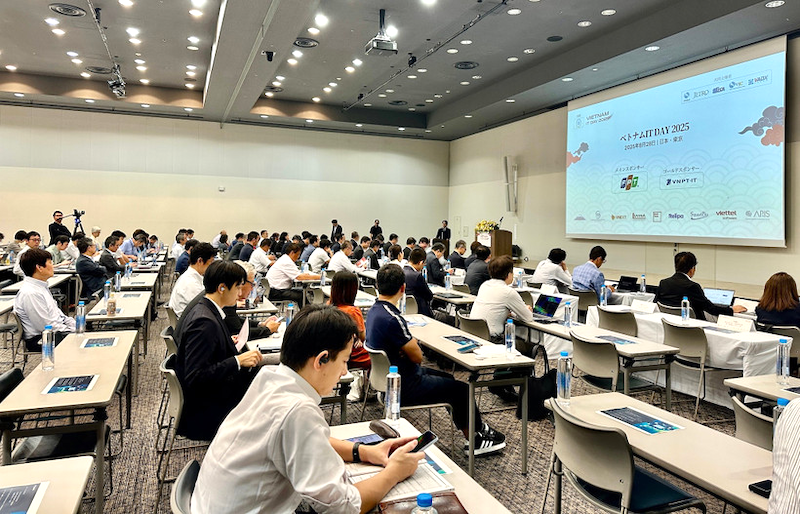
An overview of the Vietnam IT Day 2025, held on August 28 in Tokyo. Photos: VINASA
According to Nguyen Van Khoa, Chairman of the Vietnam Software and IT Services Association (VINASA), the three proposals involve the joint establishment of the Vietnam-Japan Digital Innovation Hubs, the Alliance for Global Market Expansion and the Next-Generation Tech Talent Incubator.
These joint organizations will realize the vision of “co-creating the digital future” while helping enterprises from both sides expand their reach, accelerate innovation, and strengthen competitiveness, Khoa said at the Vietnam IT Day 2025 held in Tokyo on August 28.
VINASA, the Vietnamese Association of Digital Transformation in Japan (VADX), the Japan Information Technology Services Industry Association (JISA) and the Japan External Trade Organization (JETRO) will work together on the development of these joint entities.
According to the VINASA chairman, the Digital Innovation Hubs facilitates research and development and provides a collaborative platform for Vietnamese and Japanese enterprises.
In these hubs, the two sides' businesses will cooperate to develop and commercialize products in various fields such as automotive manufacturing, finance and healthcare sectors.
The second builds an alliance of Vietnamese and Japanese enterprises, which are capable of developing solutions and competing for digital transformation projects in third markets such as ASEAN, the US, and Europe.
Under the third, VINASA with top-tier Vietnamese universities and major Japanese tech corporations will design specialized training programs in critical fields such as semiconductor chip design, AI-driven manufacturing, and green technologies.
Tailored training programs will ensure future generations of engineers and researchers are prepared to support sustained Vietnam-Japan collaboration.
"The three proposals outlined represent a significant step forward in Vietnam-Japan ICT cooperation. By combining innovation hubs, global market alliances, and next-generation talent development, both countries are positioning themselves as co-creators of digital transformation within Asia and beyond," said Khoa.
Vietnamese enterprises are capable of implementing the most complicated digital transformation and AI solutions when joining major projects in Japan's finance, retail and logistics sectors, Khoa said.
"Our businesses are geared up to accompany Japanese partners in sustainable development, especially in the fields of production management, energy optimization, carbon measurement, and automobile manufacturing," he said.
Regarding high-quality personnel, the VINASA chairman added that Vietnam has more than 500,000 ICT engineers, and some 6,000 of them are working in Japan. Local universities introduce 70,000 new engineers each year.
"The expansion of Vietnam's high-quality manpower enables local companies to take care of the most difficult projects that cost tens of thousands of working hours," Khoa said.
Bui Hoang Phuong, Deputy Minister of Science and Technology, said that Japan is a “priority market” for Vietnamese digital enterprises to realize their "going global" strategies.
He highlighted the role of state agencies, particularly the Office of Science and Technology in Japan, in guiding and supporting enterprises as they enter new markets.
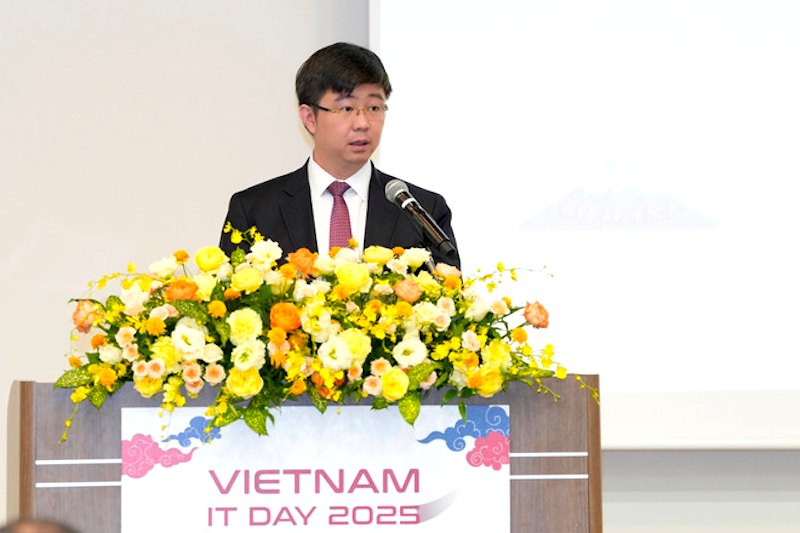
Bui Hoang Phuong, Deputy Minister of Science and Technology, speaks at the Vietnam IT Day 2025 in Japan.
Phuong called for the development of a digital knowledge platform to connect Vietnamese scientists with global experts, enabling technology solutions tailored to national challenges.
The deputy minister highlighted opportunities for Japanese enterprises to expand partnerships in software, digital services, and new technologies.
He recommended that Vietnamese and Japanese companies co-invest in AI and semiconductor R&D through joint labs and innovation centers.
Phuong also called on Japanese firms to help link Vietnamese startups with Japanese supply chains, and strengthen human resource development via training and exchange initiatives.
Shared priorities in digital infrastructure
According to Ishida Eiji, Director of the International Digital Infrastructure Promotion Division, Global Strategy Bureau, under Japan’s Ministry of Internal Affairs and Communications, AI, cybersecurity, quantum data, and next-generation data centers are the critical pillars of digital infrastructure.
He said that these are also the fields Japan is focusing on to "boost competitiveness and safeguard national security.”
“Vietnam is an important partner of Japan that is capable of co-developing digital infrastructures and talents,” Ishida added.
Junya Kawamoto, Chairman of JISA’s International Cooperation Committee, said that Japan’s digital competitiveness has dropped to 38th place from the world’s number one in 1992.
“Generative AI could be a game-changer as it opens opportunities for Japan to regain technological strength and accelerate innovation,” he said.
“But to turn this opportunity into reality, we must deepen cooperation with Vietnam, a strategic partner with technological capabilities, young talents and a spirit of innovation.”
According to VINASA, Vietnam holds 6%-7% of Japan’s software outsourcing market, valued at over US$30 billion annually, while maintaining growth rates of 20%-40% each year.
Vietnam is now Japan’s second-largest partner in software development. More than 300 Vietnamese technology enterprises serve the Japanese market, with over 100 maintaining local offices in Japan.
Japan is among Vietnam's key trade partners with two-way trade reaching $46.2 billion in 2024. Japan is also one of the biggest foreign investors to Vietnam, having set up more than 5,500 projects with total registered capital of $78.6 billion as of March 2025.
According to the Japan External Trade Organization (JETRO), 60% of Japanese firms operating in Vietnam plan to expand their operations in the next 1-2 years. Half of them aim to increase purchases of made-in-Vietnam products and services.