Vietnam's PM demands measurement of administrative services
The government leader reaffirmed the importance of administrative reform, cutting costs and paperwork to create a more business-friendly environment.
THE HANOI TIMES — Prime Minister Pham Minh Chinh on August 4 asked for an assessment index to measure public satisfaction with government agencies and administrative service delivery.

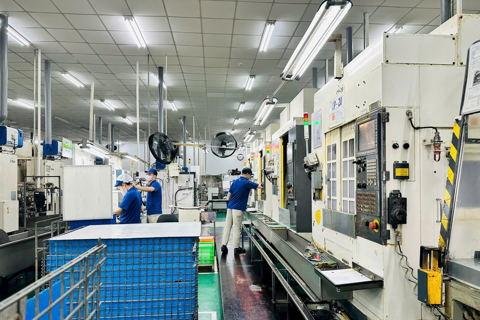
Production line at Kalotec Vietnam Ltd Co in Hanoi's Quang Minh Industrial Park. Photo: Pham Hung/The Hanoi Times
The index is crucial to evaluating government bodies’ quality in driving socio-economic growth, he spoke at the first meeting of the national steering committee on private sector development as per Resolution No. 68-NQ/TW.
The prime minister urged government agencies to strengthen open dialogue with stakeholders, streamline administrative procedures, reduce compliance costs, and decentralize authorities, and remove institutional bottlenecks to promote a healthier business environment and boost private sector growth.
“Government bodies must amend regulations on taxes, fees, land and resource access, interest rates, science and technology, and digital transformation to strengthen the competitiveness of private enterprises,” the prime minister said.
Prime Minister Chinh assigned the Ministry of Finance to support small- and medium-sized enterprises (SMEs) and household businesses, and increase the number of global, multinational corporations.
According to the Ministry of Finance, three months after the implementation of Resolution 68, there have been positive changes in the mindset and awareness across society regarding private sector development. As of July 31, half of all provinces and cities, and 21 ministries and central-level agencies, issued their action plans to implement the resolution. Accordingly, they planned to cut 56% of nearly 4,900 administrative procedures and 23% of 7,800 business conditions.
Between January and July, Vietnam recorded 107,700 new businesses, up 11% on-year. The total additional registered capital of active businesses exceeded VND2.4 quadrillion (US$91.5 billion), rocketing 186% from the same period last year.
The number of household businesses registered in January-July soared 165% year-on-year to nearly 536,200.
The January-July period also saw more than 66,300 businesses resume operations, up nearly 50% year-on-year.
Chairman of FPT Corporation Truong Gia Binh described Resolution 68 as “a ray of light amid a difficult geopolitical and economic context.”
“It sends a strong message that Vietnamese private enterprises are now trusted and given real opportunities to grow,” he said.
He called for the creation of a comprehensive national-private sector development program, connecting central and local levels, aligning the government and businesses, and integrating long-term strategies.
Binh also suggested developing a set of indicators and digital tools to monitor the implementation of Resolution 68 in a transparent and timely manner to enable effective policy adjustments.
“If this is implemented effectively, it will help rebuild trust and inspire the business community to take stronger actions,” he added.
Hanoi focuses on changing the government’s attitude toward businesses
At the meeting, Chairman of the Hanoi People’s Committee Tran Sy Thanh said that government agencies must change their approach in dealing with businesses and citizens.
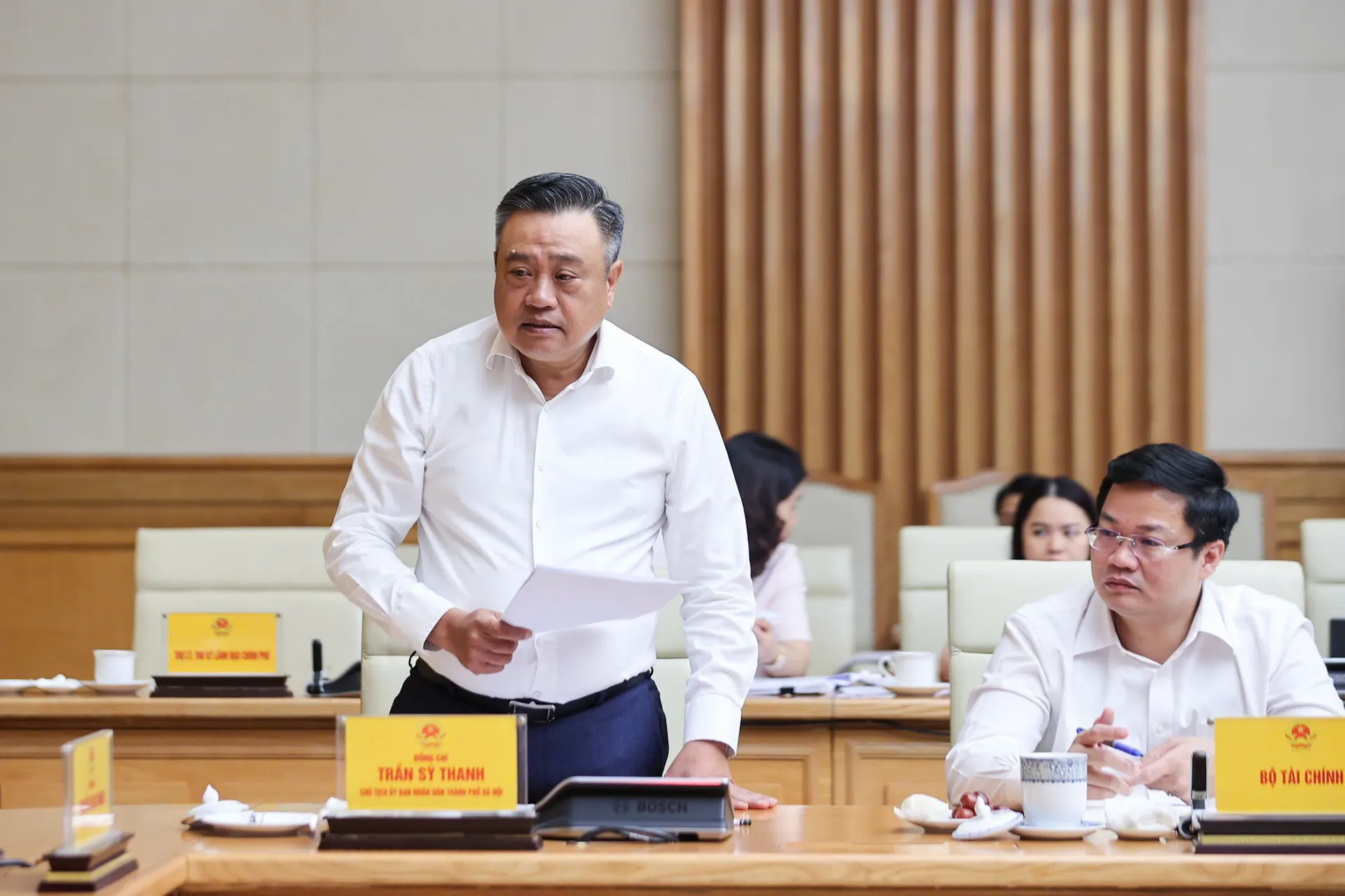
Chairman of the Hanoi People's Committee Tran Sy Thanh speaks at the conference on August 4. Photo: VGP
“Hanoi has taken concrete steps to stand alongside businesses by issuing a number of support policies for SMEs, especially for the 2026–2030 period,” he said.
The capital has launched different programs to support training and consulting for new firms and startups, boost domestic demand, and increase retail sales.
In H1/2025, Hanoi helped establish over 13,000 new businesses and supported thousands of others in their digital transformation journeys. Training courses on entrepreneurship and digitalization were also held, with special attention given to women-owned businesses.
Thanh said that government officials must change their reluctant attitude toward local enterprises, as this fundamental shift is essential to restoring public and business trust. “Trust begins with readiness. Public officials must be willing to meet with businesses and listen to their challenges.”
Hanoi is taking bold steps to promote the private sector as a driving force in its socio-economic development, he added.
According to the city’s plan to implement the Politburo's Resolution 68-NQ/TW on developing the private sector, the Hanoi Party Committee aims for the private sector to play a pivotal role by 2030, especially in science, innovation, and digital transformation.
By the end of 2025, Hanoi targets the private sector to lead in science, innovation, and digitalization.
The city aims for at least 60% of SMEs to receive training in business management and digital transformation; over 80% of businesses to use e-contracts; and over 50% of SMEs to use digital platforms.
Hanoi also expects to have 230,000 active businesses by that time, with at least three large enterprises capable of joining global value chains and leading the region’s private sector competitiveness.
On July 24, the Hanoi People’s Committee issued Plan No. 196/KH-UBND to correspond with the government’s action plan for carrying out Resolution 68.
This move is intended to turn the private sector into a core driver of growth, helping build a prosperous, happy, and modern capital city – one that is steeped in heritage and ready to lead Vietnam into a new era of national renewal.