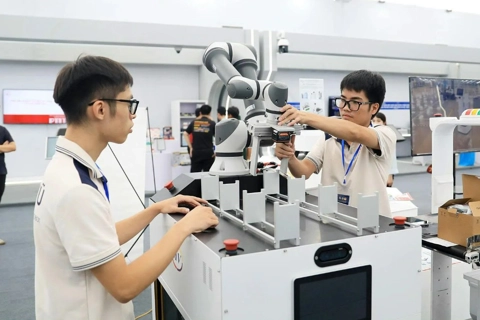
Vietnam steps up English education to build a globally ready generation
Fluenty in a foreign language is seen as an advantage for students, opening up opportunities for Vietnamese people in higher education and employment in a globalized economy.
THE HANOI TIMES — Vietnam is racing to make English its second language by 2035, part of an ambitious push to equip the next generation with the skills needed to thrive in a fast-changing global economy.
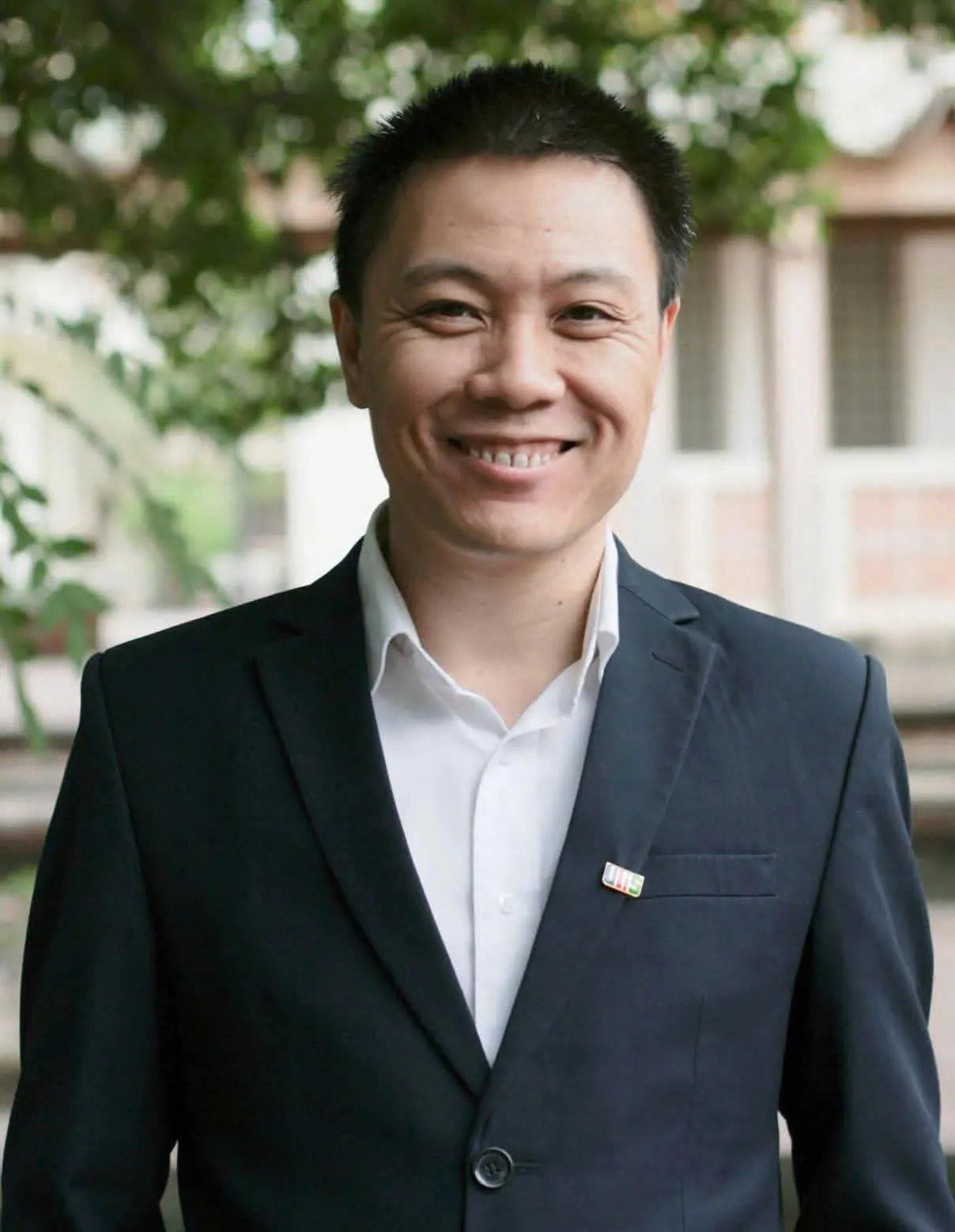
Nguyen Ninh Bac, Deputy Head of Education Quality Management Department at the University of Languages and International Studies (ULIS) under the Vietnam National University – Hanoi. Photo: Anh Kiet/The Hanoi Times
A new government decree on foreign language teaching, issued in September 2025, sets a nationwide framework to improve proficiency levels, standardize training and promote bilingual education from early grades.
“The decree ensures consistency in teaching quality and helps learners access global knowledge through modern materials and methods,” said Nguyen Ninh Bac, Deputy Head of the Education Quality Management Department at the University of Languages and International Studies (ULIS) under the Vietnam National University - Hanoi.
He told The Hanoi Times that the policy is Vietnam’s determination to build a workforce capable of working in international environments, as the country deepens its participation in global supply chains and education systems.
Under the new framework, key subjects such as math, science, technology and informatics will be taught in foreign languages at the general education level, an approach designed to link Vietnamese students directly with global sources of knowledge.

Nguyen Thi Thu Thuy, an experienced history teacher of Hanoi-based Lomonosov Education System. Photo: Anh Kiet/The Hanoi Times
Nguyen Thi Thu Thuy, a history teacher at the Hanoi-based Lomonosov Education System, said that this shift is vital in the digital era, helping students access the latest innovations and academic developments.
“In my classes, I integrate English naturally, using it for universal terms and encouraging students to express ideas in both languages. This avoids rote translation and promotes genuine understanding,” Thuy talked to The Hanoi Times.
However, she said, teacher training remains a major challenge, as educators must combine both subject expertise and international-standard language skills.
A report by the Hanoi Department of Education and Training shows that the city will need around 5,000 additional preschool English teachers, 3,000 for primary schools, and 50,000 trained to teach other subjects in English by 2030.
Tran The Cuong, Director of the Hanoi Department of Education and Training, said that not only English teachers but also subject teachers and school administrators must improve their language capacity to support bilingual environments, especially in rural areas.
From pilot programs to nationwide rollout
Several schools in Hanoi, including the Lomonosov Education System, have already piloted bilingual programs, teaching more than 15 subjects in English, from math and science to economics & law education.
At ULIS, English is being introduced as a second language across affiliated secondary and high schools. In Ba Vi Commune, local schools have focused on improving English education since 2019, collaborating with technology partners and providing digital teaching tools for teachers.
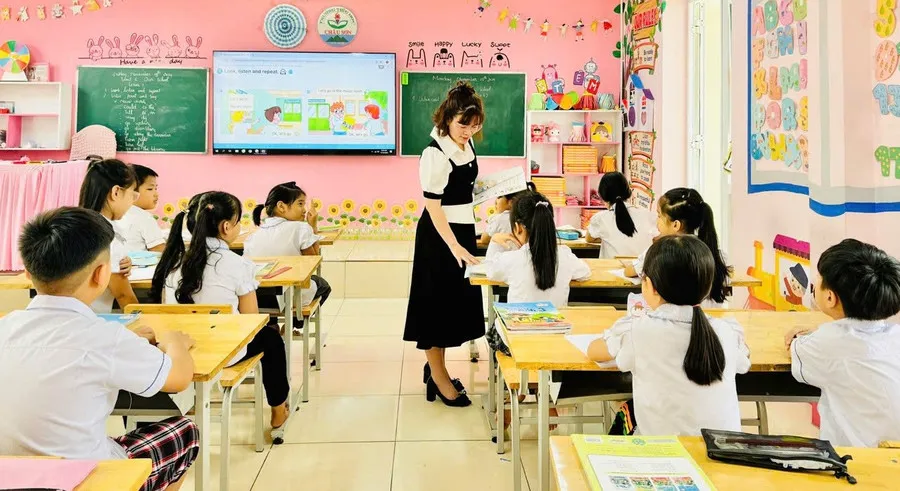
An English class at Chau Son Primary School in Ba Vi Commune on the outskirts of Hanoi. Photo courtesy of the school
“Ba Vi faces more challenges than urban wards, but we have made progress,” said Dinh Thi Ngoc Dung, an English teacher at Dong Thai Secondary School.
She told The Hanoi Times the commune has piloted English instruction in all 35 secondary schools and plans to expand to all 69 secondary and primary schools by 2030.
“To create an immersive learning environment, schools display bilingual banners, host English-speaking contests and organize reading festivals,” said Dung.

Dinh Thi Ngoc Dung (center), an English teacher at Dong Thai Secondary School in Ba Vi Commune, makes presentation about methods of foreign language teaching and learning. Photo courtesy of Dung
Focus shifted from scores to global citizenship
The shift in language policy is also changing how students and parents view education, from studying to get a job to studying to become global citizens.
Nguyen Phuong Uyen, a student at Hanoi-based RMIT University Vietnam, said she chose International Communications to prepare for a career in an international organization.
“I enjoy learning about other cultures and want to work in a global environment. I have actively asked about international joint programs and majors offering opportunities to work abroad or in multinational corporations,” she shared with The Hanoi Times.
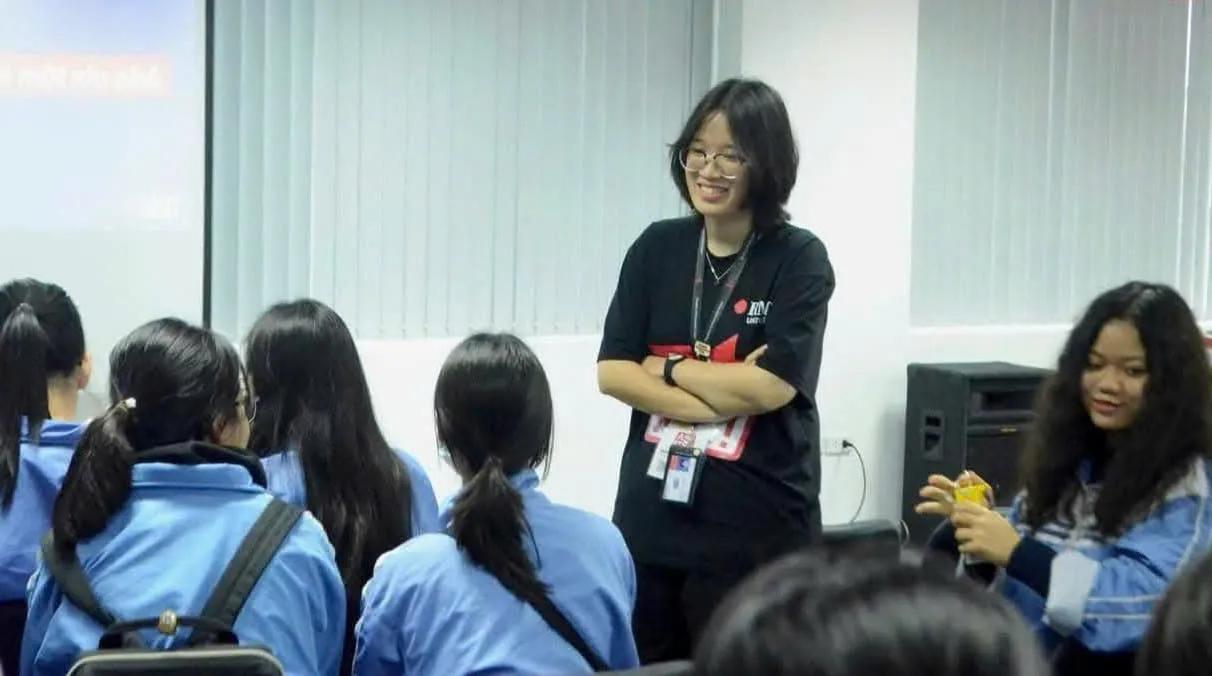
Nguyen Phuong Uyen, a student of Hanoi-based RMIT University Vietnam, is presenting at a practical exchange session with another university. Photo courtesy of Uyen
Vu Doan Mien, whose daughter Vu Anh Phuong studies at Nguyen Tat Thanh Secondary and High School in Cau Giay Ward, said he encourages her to follow her passion for International Relations despite the field’s demanding language requirements. “What matters most is passion and capability,” he said, adding that without that, even a global major can become unsustainable.
Hanoi currently ranks third nationwide in foreign language proficiency and aims to establish English as a second language across schools in the coming years.
“Students today are increasingly drawn to globally oriented majors. We encourage them to gain practical experience through exchange programs, competitions, and community work to build confidence and adaptability,” said Deputy Head Nguyen Ninh Bac.
“Don’t hesitate to sign up and explore. Volunteering or joining international organizations is a great way to gain real-world experience and develop skills,” Bac advised young people.
He noted that the diversity in Hanoi's training majors reflects the capital’s comprehensive approach to human resources development, ensuring that graduates are prepared to meet the demand of various industries and sectors.
Director Tran The Cuong said that educating students to become global citizens requires a focus on foreign language training alongside comprehensive knowledge acquisition and IT competence, calling it a crucial task to help students seize a wider range of development opportunities.
He stressed that language training must go hand in hand with digital literacy and global awareness, forming the foundation for Vietnam’s future workforce.
“Foreign language proficiency helps students engage in cultural exchange, enhances competitiveness and contributes to the country’s sustainable development,” said Cuong.
Vietnam’s 2035 roadmap puts English proficiency at the core of education reform, aiming to build a globally skilled workforce. With stronger teacher training and digital learning, the policy envisions language as a driver of innovation and competitiveness, reshaping how Vietnam connects with the world.