Vietnam wastes US$3 billion from unrecycled plastic litter annually
Collective actions are aimed to boost the engagement of the private sector and empower informal waste workers and strengthen their resilience to vulnerabilities.
Vietnam fails to get nearly US$3 billion annually because it does not recycle all plastic waste from domestic waste, according to the United Nations Development Fund (UNDP).
| The partnership between UNDP and Binh Dinh Province on plastic waste management. Photo: UNDP |
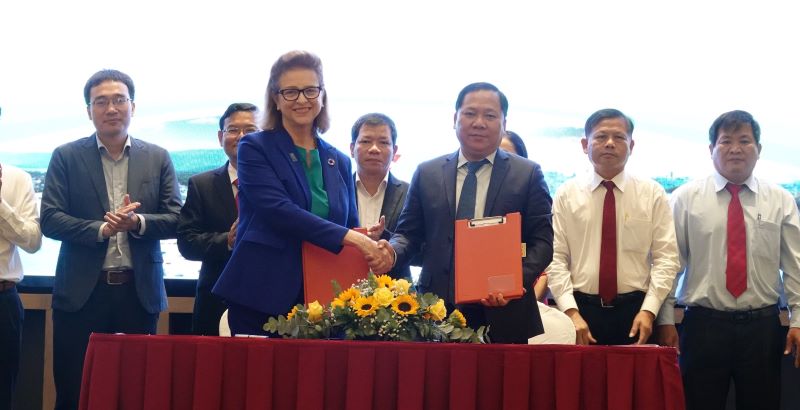
UNDP Vietnam Resident Representative Caitlin Weisen shared the view at a workshop on collective actions to improve solid waste and plastic management in the central province of Binh Dinh.
Weisen highlighted the issue in the context that Vietnam is one of the countries that generate a large amount of plastic waste into the ocean and the majority of plastic waste is not recycled properly to make full use of this kind of material.
“Tackling marine plastic is vital to the health of our oceans, people and planet and requires an integrated approach that shifts behaviors to reduce plastic use at source while engaging all players in the value chain to ensure that plastic that is used gets re-used,” Wiesen emphasized.
To help Vietnam tackle waste generation, UNDP continues its ongoing projects that deliver on the United Nations Agenda 2030 in Vietnam by taking an integrated approach to tackling environmental and social challenges.
Specifically, the new partnership with Binh Dinh will combine work at the policy level with the implementation of the National Action Plan on Marine Plastic Litter, improving regulations with grassroots initiatives driven by vibrant community organizations, and boosting private sector engagement through waste value chains with the establishment of the first inclusive Material Recovery Facility (MRF).
MRF is under the project entitled Scaling-up Integrated and Inclusive Waste Management Models through Empowering the Informal Sector and Fostering the Circular Economy funded by the Norwegian Embassy in Vietnam.
In Binh Dinh, UNDP is working with local agencies to deploy MRF that aims to increase the value of plastic waste and recyclable materials with the engagement of the private sector and informal waste workers. It is expected that the MRF could be a solution to help Quy Nhon City to tackle the waste generation of 291 tons per day of which about 70 tons are plastic. It would help Quy Nhon City to prevent plastic from ending up in landfills or the environment.
UNDP is also piloting a waste management model in the fishery sector, in which fishermen are encouraged to bring back their waste to shore after every sea journey. Their joint efforts are expected to collect and avoid around five tons of plastic per month from entering the sea.
As Law on Environmental Protection has been in place since 2020 and it is obliged to do waste sorting at source since 2024, this project is well aligned with this strategy and will provide technical support to Binh Dinh province so that Binh Dinh can be one of the pioneers in implementing this important policy and become a role model for others.
Wiesen expected that the project on the reduction of marine plastic pollution in Binh Dinh would become a model for others to replicate in Vietnam and the ASEAN region.
Land-based plastic waste sources are considered the main source of waste and, on a larger scale, sources in the ocean. Specifically, up to 80% of plastic waste comes from the mainland, that is, from production and human activities; the remaining 20% comes from fishing, aquaculture, and vessels during their voyages.
Along with that, the strong development of the tourism industry and the increase in population make the daily amount of untreated waste discharged into the environment higher and higher, causing serious harm to the environment in coastal areas and islands, significantly damaging the seagrass and coral ecosystems in protected areas.
Vietnam is facing the problem of resource depletion and waste increase, especially ocean plastic waste.
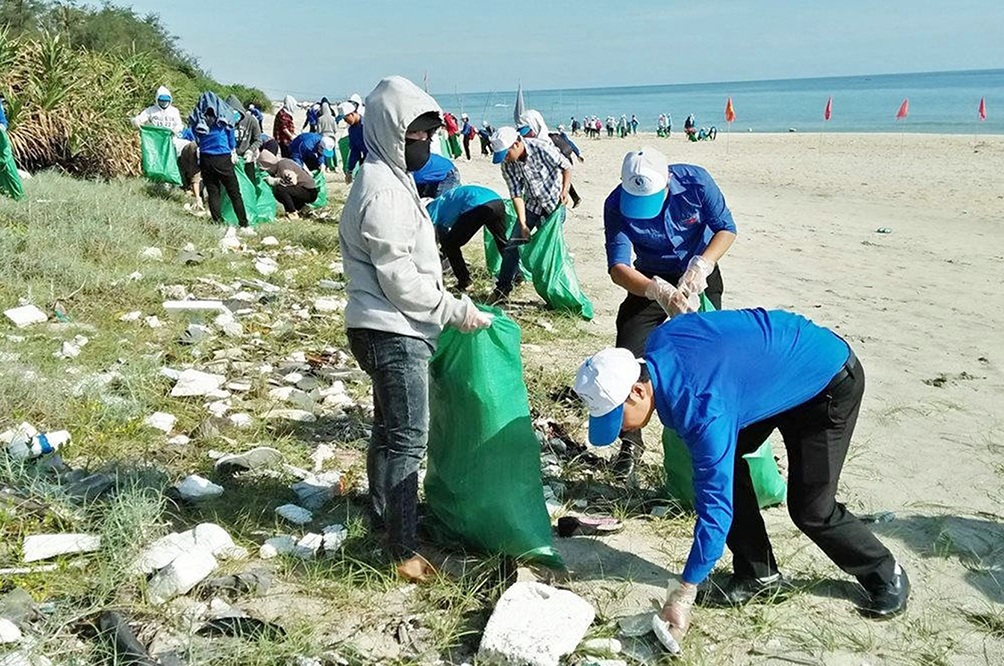
| Young people in Ba Ria-Vung Tau Province collect plastic litter on beach. Photo: V.D |
![[Efforts against pollution] Behavior change needed for solid waste management in Vietnam: Experts](https://cdn-media.hanoitimes.vn/2022/06/09/SPEAKERS.JPG.jpg?w=480&h=320&q=100)