Vietnamese Gov’t to allocate US$6.5 billion for North-South expressway projects
Once completed in 2025, the Government would start collecting fees to recover part of its investment capital.
The Vietnamese Government is planning to allocate VND146.9 trillion (US$6.5 billion) to finance the construction of the entire 12 sub-components under the Eastern North-South expressway project in the 2021-2025 period.
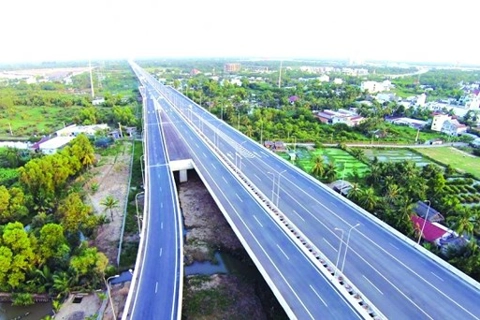
| North-South Expressway. Photo: Tran Dung |
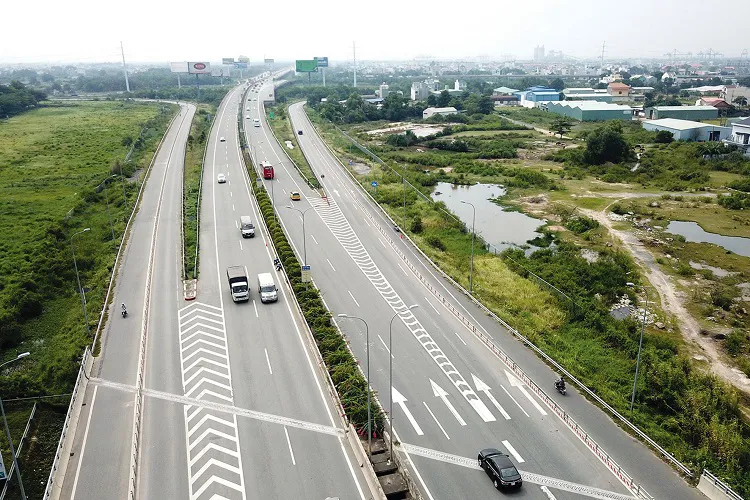
The move was revealed in a feasibility study report on the project submitted to the National Assembly for review. Once completed in 2025, the Government would start collecting fees to recover investment capital.
Upon breaking down, the cost for construction and equipment should be around VND96 trillion ($4.2 billion), VND19 trillion ($835.1 million) for site clearance and resettlement of affected households, VND12 trillion ($527.4 million) for project management fees, and VND20 trillion ($879 million) backup funds.
The latest proposal marked a major change in Government stance as initially nine sub-components under the project would be financed through public-private partnership (PPP). These projects span 552 kilometers, consisting of sections from Bai Vot (Ha Tinh) to Vung Ang (Ha Tinh), Cam Lo (Quang Tri) – Nha Trang (Khanh Hoa), Cantho – Ca Mau.
Only the three remaining subprojects of Vung Ang – Bung, Bung – Van Ninh, Van Ninh – Cam Lo with a combined length of 177 kilometers were subject to public funding.
The Government noted a change in the funding mechanism was aimed at facilitating the construction progress of national priority projects.
“A push for public investment is an urgent task, especially in the expressway projects, and in this case, the Eastern North-South expressway is significant for Vietnam’s economic development,” stated the report.
The Eastern North-South expressway with a total length of 729 kilometers with 12 sub-components runs from Bai Vot (Ha Tinh Province) to Cam Lo (Quang Tri Province), from Quang Ngai Province to Nha Trang Province, and from Cantho to Ca Mau Province.
During the first phase, the expressways would be designed with four lanes of 17 meters wide, before being widened to six lanes and 32 meters, with vehicles that could travel up to 120 kilometers per hour.
Under the authorities’ calculation, toll collection on the entire 12 sub-projects in five years would help raise VND18.3 trillion (USD804.5 million) in five years around VND38 trillion ($1.67 billion) in the 10-year period.
In case the number of tollways is reduced to eight, the figures in five and 10 years are estimated at VND14.8 trillion ($650.5 million) and VND30 trillion ($1.31 billion), respectively.
As of present, over 1,000 kilometers of the expressway have been built throughout the country, while the addition of 900 kilometers is expected to be completed by end-2021.
In the 2021-2025 period, Vietnam targets to have at least 2,000 kilometers of expressways, and by 2025, the figure would be 4,000 kilometers stretching from the northern province of Lang Son to the southernmost province of Ca Mau.
With the Eastern North-South expressway, Vietnam would have four major trans-Vietnam highways, including National highway No.1, Ho Chi Minh highway, and coastal highway.