Amended Capital Law to help Hanoi realize Red River zoning plan
It is critical to put available riverbank land to good use in order to enhance landscape, cultural, economic, and tourism values while ensuring flood and disaster prevention.
The amended Capital Law made it a matter of urgency for Hanoi to focus its resources and prioritize the realization of zoning plans for the Red and Duong Rivers in line with the Capital's Master Plan and the General Capital Plan.
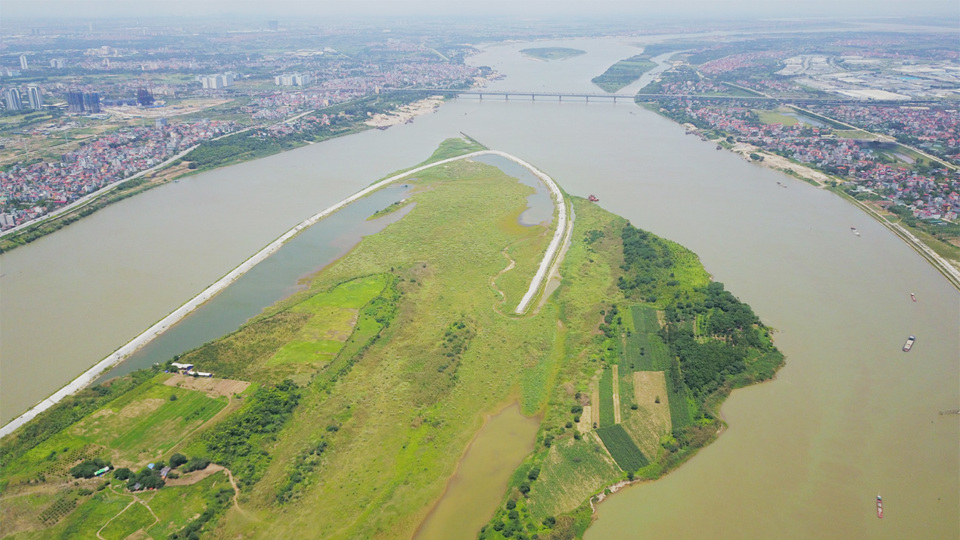
| The Red River from above. Photo: Hai Linh/The Hanoi Times |
Article 17 of the amended Capital Law stipulates that the construction and development of Hanoi must adhere to the Capital's Master Plan and General Plan.
These plans must ensure “the development of a civilized, modern, and sustainable capital with a clean living environment and secured water sources, with the Red River serving as the central green axis and landscape, promoting harmonious urban development on both sides of the river.”
They must also ensure national defense and security, connect the capital's technical and social infrastructure with localities engaged in regional development, and allocate resources to prioritize the implementation of zoning plans for the Red River and Duong River in accordance with the Capital's Master Plan and General Plan. The construction of new dikes is permitted in compliance with flood control plans, dike planning, and other relevant regulations to optimize land use.
Existing residential areas in the riparian zone are allowed to stay in place, and new construction of new structures and dwellings is authorized in appropriate numbers, subject to flood protection and other relevant plans. It is possible to build public areas and infrastructure on riparian land without obstructing the flow of water.
The Hanoi People's Committee is empowered to adjust environmental zoning within the Capital Plan, make minor adjustments to urban general plans, functional area plans, and specialized technical infrastructure plans approved by the Prime Minister, and report the results to the Prime Minister.
The municipal People's Council will detail the procedures for adjusting environmental zoning and local planning adjustments.
For areas with approved general or sub-zoning plans and district construction plans, there is no need to create new district land use plans. Instead, the annual district land use plans will be based on the general or sub-zoning plans, the district construction plans, and the land use targets set out in the Capital's General Plan and the local targets.
In practice, the city has developed several plans for the Red River segment through Hanoi but has faced implementation challenges, partly due to outdated flood control and dike planning and regulations. Based on feedback from the National Assembly and the Government, the law allows for the construction of new dikes in line with flood control dike planning and other related plans.
Discussing this issue, National Assembly Deputy Dao Chi Nghia from the Cantho delegation noted that delegating the implementation of the Red River and Duong River sub-zoning plans to Hanoi, once the Capital's Master Plan and General Plan are approved by the Prime Minister, will shorten the implementation process.
This will ensure strict adherence to regulation and lay down timely and procedural conditions for Hanoi to meet the public's needs for community cultural spaces, green-clean-beautiful landscapes with the Red River as the central landscape axis, and harmonious urban development on both sides of the river, in line with Resolution No. 15-NQ/TW dated May 5, 2022, of the Politburo on the direction and tasks for Hanoi's development to 2030, with a vision to 2045, he said.