Chinese private firm accelerates major infrastructure projects in Vietnam
CPCG is implementing three major projects in Hanoi, including the Tu Lien Bridge and its approach roads, launched in May 2025; the Ngoc Hoi Bridge and its approach roads, started in August 2025; and Urban Railway Line 5 from Van Cao to Hoa Lac, which broke ground in December 2025.
THE HANOI TIMES — China Pacific Construction Group (CPCG), one of China’s largest private enterprises, expects to continue taking part in major infrastructure projects and deepen long-term cooperation in Vietnam.
Yan Jiehe, Founder of CPCG, outlined the group’s cooperation plans, including partnerships with Vietnam Railways on a railway industrial complex, participation in metro projects in Hanoi and Ho Chi Minh City and a range of urban infrastructure works in the capital.
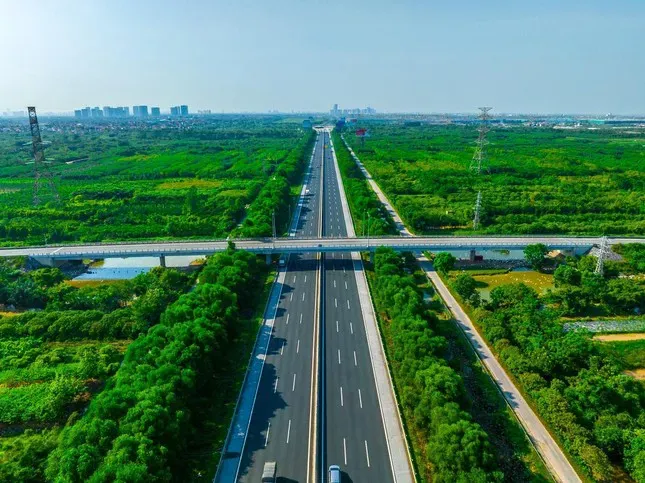
Hanoi increases investment in transport infrastructure. Photo: Kinh te & Do thi Newspaper
He said CPCG has won bids for and is implementing three major projects in Hanoi: the Tu Lien Bridge and its approach roads, launched in May 2025; the Ngoc Hoi Bridge and its approach roads, started in August 2025; and Hanoi urban railway Line 5 from Van Cao to Hoa Lac, which began construction in December 2025.
He reaffirmed the group’s desire to remain involved in large-scale infrastructure projects in Vietnam in line with the prime minister’s orientation.
China Pacific Construction Group specializes in infrastructure investment, construction, operation and management and has ranked among the world’s top 500 largest groups for ten consecutive years.
In Vietnam, the group has focused on public–private partnership models and transport infrastructure, signing multiple cooperation agreements with local partners.
Notably, CPCG has worked with the Hanoi Department of Transport and Vietnamese firms to study and invest in Light Rail Line 5 and bridge projects across the Red River, with a total planned investment of VND85 trillion ($3.23 billion).
Through joint ventures with Chinese partners, the group has played a leading role in the consortium that won the bid for Hanoi Metro Line 5, with an estimated investment of more than VND74 trillion ($2.8 billion). The project is scheduled for completion in 2029 and commercial operation in 2030 under Hanoi’s urban development master plan.
Beyond urban rail, CPCG has expanded into major bridge projects in Hanoi, including the Tu Lien Bridge, the Ngoc Hoi Bridge and their approach roads. It has also secured another bridge and approach road project spanning about 7.5 kilometers.
Outside the capital, the group has proposed a road tunnel across Cua Luc Bay in Quang Ninh, withan estimated investment of around VND10 trillion ($380 million) and a proposed timeline from 2025 to 2030.
CPCG has also engaged with authorities in Nghe An, Haiphong, Bac Ninh and Ninh Binh to study potential investments in railways, expressways, seaports and urban development.
Vietnamese leaders at both central and local levels have encouraged CPCG and other Chinese firms to explore major infrastructure projects, prioritizing metro systems, connectivity bridges, interregional railways and expressways.
The group has maintained a representative office and a subsidiary in Vietnam since 2019, underscoring its long-term commitment and plans to expand operations in the country.
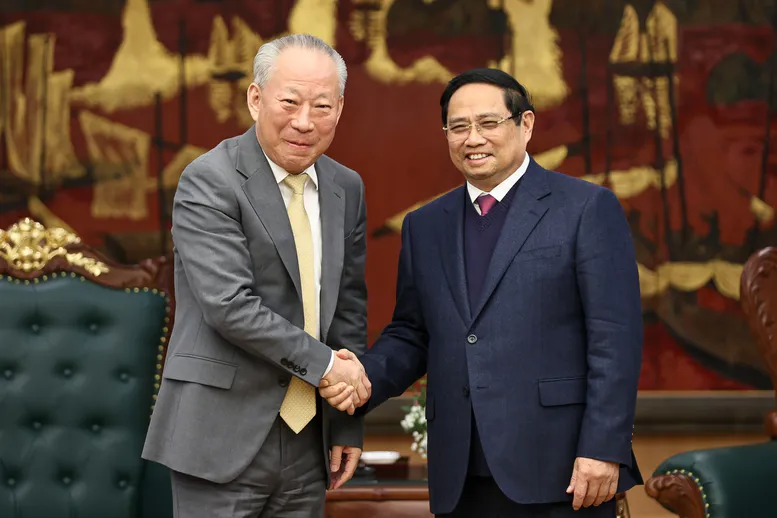
Vietnam’s Prime Minister Pham Minh Chinh (R) and Yan Jiehe, Founder of China Pacific Construction Group, in Hanoi on January 9. Photo: Nhat Bac/VGP
At the meeting with the Chinese investor in Hanoi on January 9, Prime Minister Pham Minh Chinh praised the group’s recent role as a contractor in several key projects in Hanoi. He supported CPCG’s proposals to join major infrastructure developments in the coming period.
The prime minister encouraged the group to expand investment, strengthen cooperation with Vietnamese enterprises and deliver concrete and emblematic projects linked to technology transfer.
He said such efforts would support Vietnam’s socio-economic development and further advance bilateral ties in a positive and mutually beneficial direction.
Highlighting the need for long-term planning and strategic vision, Chinh suggested that CPCG continue studying projects that could better unlock development potential, including a proposed underground railway linking Tan Son Nhat Airport with Long Thanh Airport.