Gia Binh Airport – Hanoi link named national key project
The planned Gia Binh Airport–Hanoi road will be 35 km long and 120 m wide, with a total investment of VND71.150 trillion (US$2.8 billion).
The project to build a road linking Gia Binh Airport to Hanoi has been added to the list of national key projects in the transport sector.
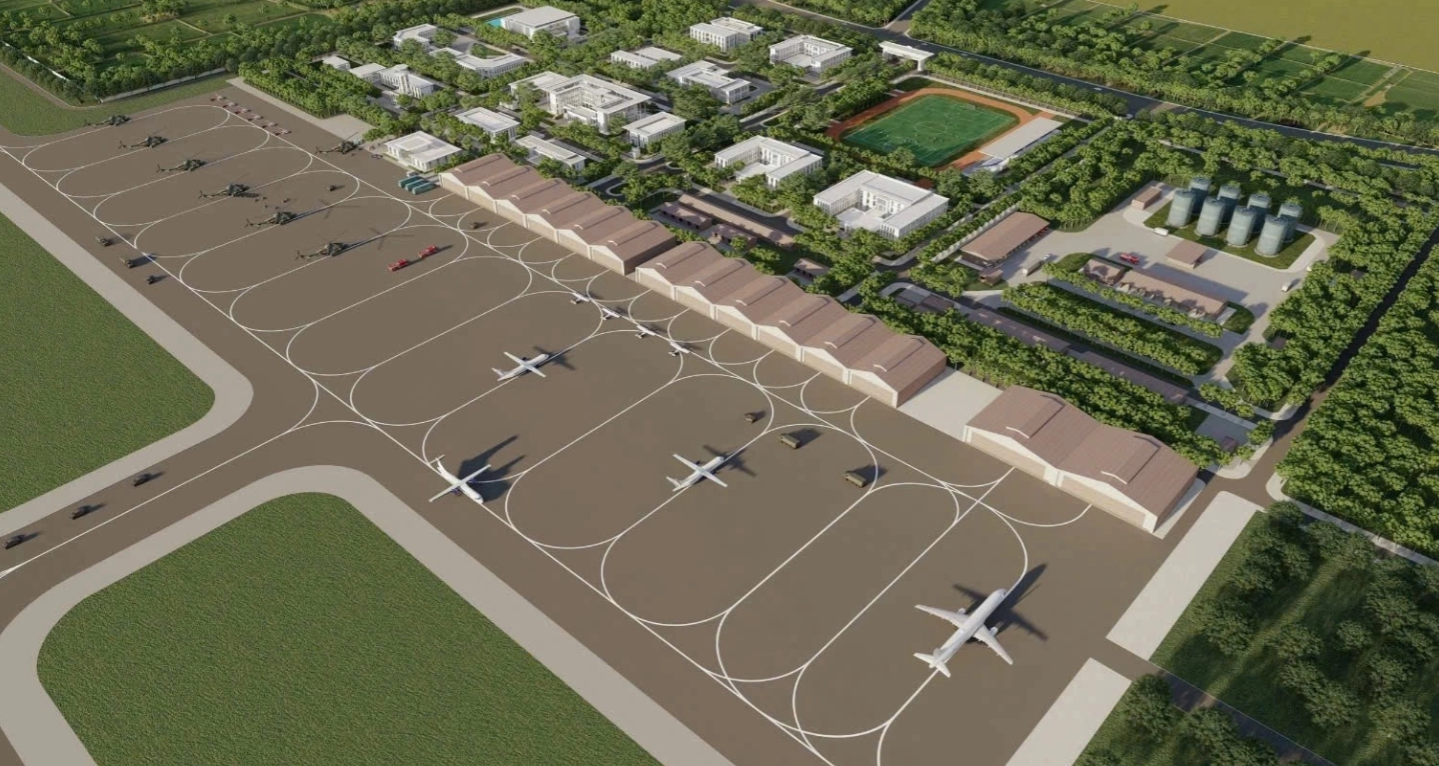
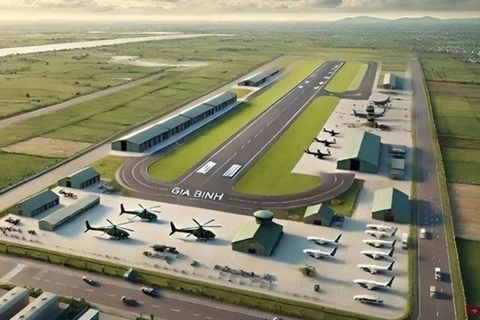
The design of the Airport. Photo: Sun Group
Under the Prime Minister’s decision on August 6, other additions to the list include several expressways, Cho Moi–Bac Kan, Bac Kan–Cao Bang, Hoa Binh–Moc Chau, Vinh–Thanh Thuy, Cam Lo–Lao Bao, Quang Ngai–Kon Tum, Quy Nhon–Pleiku, Ca Mau–Dat Mui, and the expansion of the eastern section of the North–South Expressway under a public-private partnership (PPP). The list also now includes the expansion of the Hoa Lac–Hoa Binh and Ho Chi Minh City–Trung Luong–My Thuan expressways, the road connection to Hon Khoai Port, the Hon Khoai Port project, and the upgrade of Ca Mau Airport.
With the new additions, the list of national key transport projects now exceeds 20. The planned Gia Binh Airport–Hanoi road will be 35 km long and 120 m wide, with a total investment of VND71.150 trillion (US$2.8 billion). It will start at Gia Binh Airport in Bac Ninh Province and end at the Tu Lien Bridge access road, connecting to Hanoi’s Ring Road 3.
Within Hanoi, the route spans 14 km. Of this, a 7 km section from the Bac Ninh–Hanoi border to the interchange between Ring Road 3 and the Hanoi–Lang Son Expressway will be newly built. The remaining 7 km, overlapping with the Hanoi–Thai Nguyen Expressway and Ring Road 3, will be widened from 35 m to 120 m.
Vice Chairman of the Hanoi People’s Committee Duong Duc Tuan, during a government meeting on May 10, noted the Hanoi section has an estimated investment of VND42.451 trillion ($1.7 billion).
Component 1, involving site clearance and resettlement within Hanoi’s boundary, will be funded entirely by the city’s public investment budget, costing around VND8.11 trillion ($324.6 million).
This cost will not be included in the value of the Build–Transfer (BT) contract for Component 2, which covers the road’s construction under a BT contract with an estimated investment of VND34.33 trillion ($1.37 billion).
For his part, Chairman of Bac Ninh Province People’s Committee Vuong Quoc Tuan proposed extending the road beyond the airport–Hanoi link (22.9 km) by an additional 8.7 km to Kenh Vang Bridge in Hai Duong Province, enhancing connectivity with neighboring provinces. This would bring the Bac Ninh section’s total length to 31.6 km with a 120 m cross-section.
The province estimates the total investment at about VND40,300 trillion ($1.6 billion) under a BT contract.
Gia Binh Airport, located in Gia Binh Commune, is planned as a 4E-class facility covering more than 1,960 ha, with two runways capable of accommodating modern aircraft such as Boeing B777, B787, and Airbus A350 and A321.
By 2030, it is projected to handle 30 million passengers and 1.6 million tons of cargo annually, rising to 50 million passengers and 2.5 million tons of cargo by 2050. The airport is expected to drive socio-economic growth in Bac Ninh and the surrounding region, particularly the Hanoi metropolitan area, while easing pressure on Noi Bai International Airport.
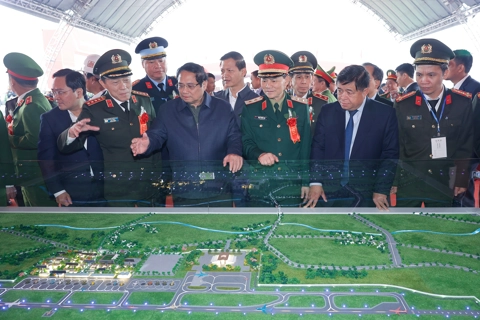
Construction of Gia Binh Airport began in December 2024 in Gia Binh District, led by the Ministry of Public Security. The 125-hectare facility is slated for completion by late 2025 and will be classified as a Class 3 helipad, a Class 3 military airport, and a Class 3C civil airport.
Under the revised 2021–2030 development plan approved by the Ministry of Construction, Gia Binh International Airport will be upgraded to meet ICAO 4E standards, with an initial capacity of one million passengers and 250,000 tons of cargo per year.
By 2050, while maintaining its 4E classification, the airport is expected to handle three million passengers and one million tons of cargo annually. Once complete, Gia Binh Airport is envisioned as a five-star international facility ranking among the world’s ten most beautiful and modern airports.