Hanoi localities ready for waste segregation pilot program
Many districts under the pilot program are intensifying efforts to raise public awareness of waste sorting at the source and the fight against plastic waste.
Starting in June 2024, Hanoi plans to install a trial closed-loop system with advanced technology for the sorting, collection, transportation, and treatment of household solid waste at the source in five districts of the city.
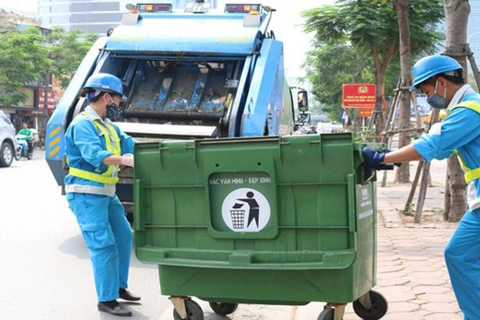
| Waste sorting in Hanoi. Photo: Lam Thanh |
In response to the Ministry of Natural Resources and Environment's directive in document No.1786 dated March 22, 2024, regarding the implementation of measures to enhance the management of household solid waste, Hanoi would test the models in five districts: Hoan Kiem, Ba Dinh, Dong Da, Hai Ba Trung, and Nam Tu Liem.
According to the plan, after the pilot phase, the involved units will summarize and draw lessons to be incorporated into the project for sorting, collecting, transporting, and treating household solid waste at the source, which will then be submitted to the City People's Committee for approval and widespread implementation.
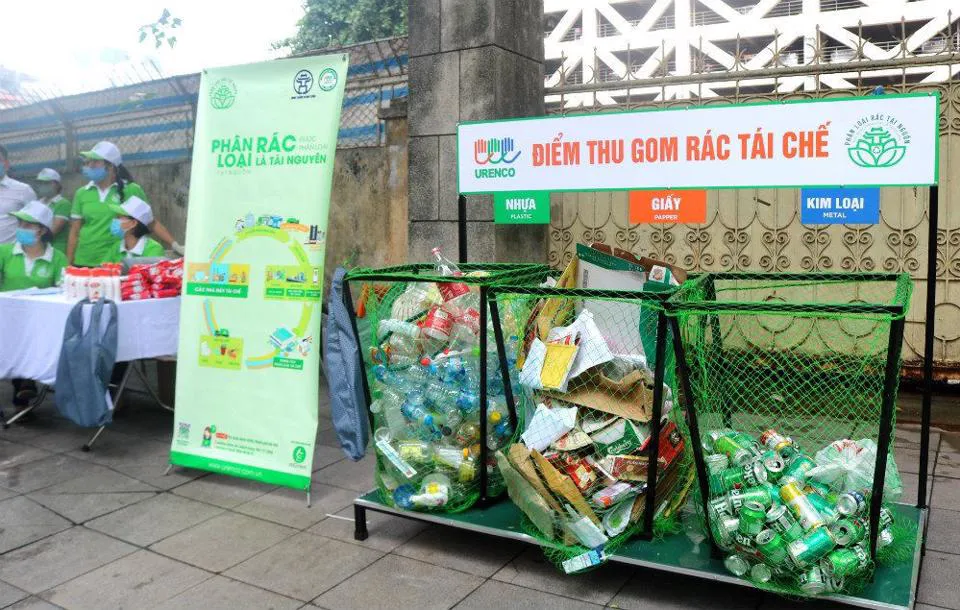
Household solid waste will be classified into four categories: recyclable waste (such as paper, plastic, and metals); bulky waste (large discarded items like furniture or tree branches); hazardous waste (batteries, chemicals, electronic devices); and other waste (food waste and miscellaneous waste).
In Hoan Kiem District, all 18 wards are expected to participate in the pilot program.
Le Anh Thu, Vice Chairman of the Hoan Kiem District People's Committee, stated that to make the program effective, the district has intensified efforts to raise awareness among officials and residents about the need to sort waste at source and the movement against plastic waste.
“We strive to ensure strict compliance with fees for waste collection, transportation, and treatment service, aiming to spread the message "little acts, big impact", she said.
Similarly, Ha Anh Tuan, Vice Chairman of the Dong Da District People's Committee, emphasized the importance of the pilot program’s proper implementation of. The district has instructed relevant units to enhance communication and educate people on how to identify different types of waste. Information about the timing and locations for sorting, collecting, transporting, and treating household solid waste has been widely disseminated.
Specifically, in Nam Dong ward, the pilot unit, recyclable household waste such as paper, books, and plastic cups is collected at designated locations twice a week. For bulky waste like furniture, the ward has set up collection points to prevent indiscriminate dumping, which harms urban aesthetics and complicates maintenance work. Regular checks are carried out to ensure that waste is sorted at source and that maintaining environmental hygiene is maintained, with strict penalties for non-compliance.
“This practice is also a criterion for evaluating cultural family titles,” said Tuan.
Addressing bottleneck
With active participation from Hanoi authorities and related units, particularly district and ward functional forces, the pilot program for household waste sorting at the source is ready. However, concerns and challenges remain in the sorting, collection, transportation, and treatment of solid waste.
An environmental sanitation company leader highlighted that according to the Ministry of Natural Resources and Environment's guidelines, household solid waste is categorized into food waste, recyclable waste, and residual waste (hazardous, bulky, and other remaining waste). However, Hanoi currently lacks the infrastructure necessary to process organic waste and bulky waste treatment.
Regulations require hazardous waste generators to have suitable facilities and equipment, yet there is no specific guidance on these requirements. Moreover, units contracted to maintain environmental sanitation and collect household waste in districts do not have the necessary permits from the Ministry to handle hazardous waste, he noted.
On May 13, 2024, the Hanoi People's Committee sent document No.1454/UBND-TNMT to the Ministry of Natural Resources and Environment, requesting guidance on environmental management under the Environmental Protection Law. Hanoi asked the Ministry to issue processes, economic norms for maintaining sanitation, and post-sorting waste management, which would create the basis for the city to design and implement technical and economic standards and pricing.
Additionally, the city’s authorities requested specific guidelines for the storage, collection, and transportation of hazardous waste from households after sorting, as well as distinct methods for managing hazardous waste from production, business, and services to facilitate broader implementation across the city.
According to the 2020 Environmental Protection Law, localities must implement waste sorting at the source by December 31, 2024, at the latest. Environmental workers will refuse to collect unsorted waste. Households and individuals who do not sort their waste or use inappropriate containers for household solid waste will be fined between VND500,000 and VND1,000,000 (US$20-$40).