Log in
Hanoi

Nine rail lines to cost Hanoi $36.3 billion

Underfunded, growing population and rapid urbanization undermine Hanoi's public transport system.

Hanoi will need some VND888 trillion (US$36.3 billion) to build nine urban railway lines, a report by the Ministry of Justice has revealed.

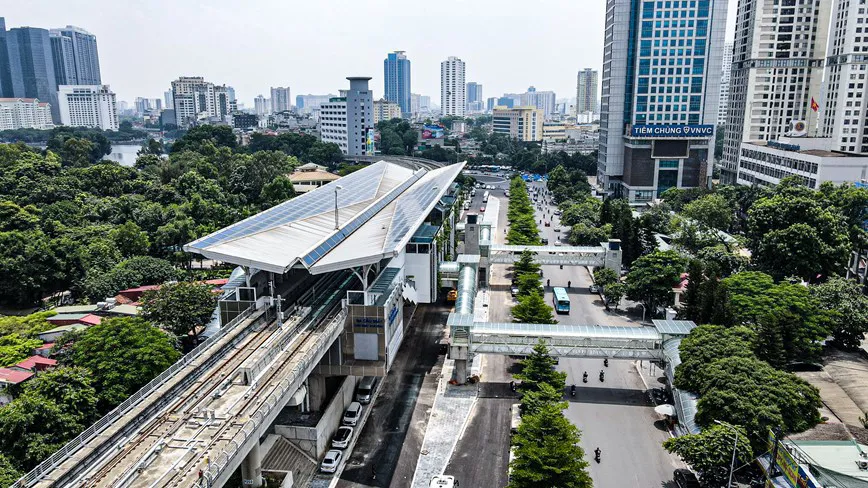
A terminal in the Nhon-Hanoi Station urban railroad project. Photo: The Hanoi Times

In a report assessing the impact of the amended Capital Law, the Ministry of Justice said Hanoi would need a total of VND4.7 trillion ($192.5 billion) to develop a comprehensive mass transit network to improve connectivity with its satellite cities.

The lack of investment capital is a major challenge for Hanoi, as the city's budget can now provide only 46% of the necessary funds for infrastructure projects, the ministry said.

According to the ministry, rapid population growth and urbanization are now outpacing the construction of transport infrastructure. Meanwhile, private investors find these projects less attractive due to the long time it takes to break even and the lack of preferential policies.

The ministry suggested Hanoi develop public passenger transport linked to urban railway lines and complete the construction of national highways, expressways, ring roads, and intra-regional and inter-regional links in accordance with urban planning.

The Ministry of Justice recommended that Hanoi authorities adopt the Transit-Oriented Development (TOD) and Public-Private Partnership (PPP) models to make more efficient use of land resources and project implementation.

The ministry also advised that the capital city auction off land rights and rights to use underground and above-ground space. The funds raised from these auctions would be invested in the construction of urban railways, their connection to public transport systems, and technical infrastructure connecting stations.

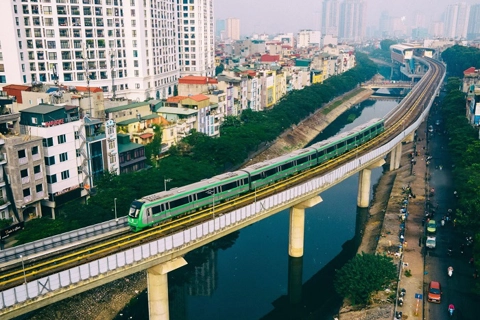
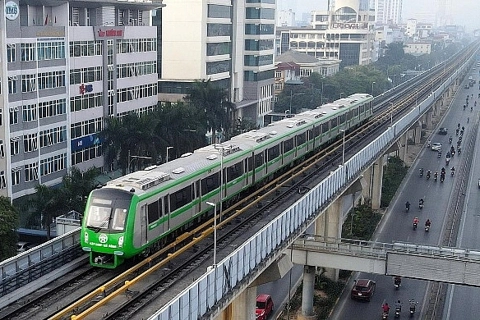
Hanoi plans to build nine railway lines with a total length of 318 kilometers across the city. Only Line 2A Cat Linh - Ha Dong is operational, four other lines have secured capital investment commitments, and the remaining lines are at the pre-feasibility stage.

The revised Capital Law is expected to provide a way out for the current situation and future of Hanoi's urban railway lines and transport infrastructure. The draft law will be submitted to the National Assembly in October.
Reactions:
Share:
Trending
Most Viewed
Related news
Hanoi gears up for a vibrant 2026 Countdown

Hanoi gears up for a vibrant 2026 Countdown

With the energy of thousands gathering in Hanoi downtown, the Countdown 2026 promises to be an unforgettable way for people to welcome the New Year.

Hanoi launches AI-powered traffic control center for traffic violations

Hanoi launches AI-powered traffic control center for traffic violations

The system automatically detects common violations, significantly reducing the need for traffic police to be deployed directly on the streets while improving accuracy and transparency in traffic management.

Hanoi plans 10,000-hectare urban megacity with world-class stadium

Hanoi plans 10,000-hectare urban megacity with world-class stadium

The stadium’s design draws inspiration from Dong Son bronze drums and the Lac bird motif, symbolizing Vietnam’s aspiration to rise.

Hanoi greenlights Olympic sports city and Red River boulevard to drive next growth phase

Hanoi greenlights Olympic sports city and Red River boulevard to drive next growth phase

The approval of two landmark projects underscores Hanoi’s push to unlock new growth engines, reshape its urban structure and accelerate its ambition to become a green, smart and globally connected capital.

Hanoi targets 1,200 supporting industry firms by 2030

Hanoi targets 1,200 supporting industry firms by 2030

The city aims to enhance the competitiveness of the capital’s industrial sector by tightening cooperation with Vietnamese enterprises and multinational corporations operating in Vietnam.

Red River Boulevards shape Hanoi’s new growth axis

Red River Boulevards shape Hanoi’s new growth axis

The creation of a landscape boulevard can help Hanoi reconnect with its historic identity shaped by water and restore the river-based character that defined the city for centuries.

Hanoi moves to strengthen urban order and civility

Hanoi moves to strengthen urban order and civility

These include expanding public communication efforts, reorganizing and upgrading streets and sidewalks, maintaining a clean and orderly urban environment and carrying out strict inspections to address violations.

Hanoi honors 87 entities and buildings for using green energy

Hanoi honors 87 entities and buildings for using green energy

Enterprises adopted highly automated technologies in line with Industry 4.0 standards and all businesses in industrial parks, clusters, rural industries and craft villages will keep applying energy-efficient measures.