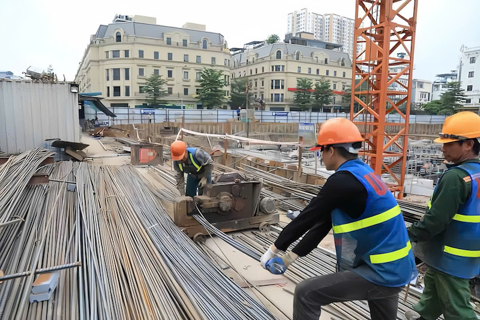
Van Cao – Hoa Lac metro line opens prospects for Hanoi’s urban development
The line is a strategic infrastructure project that plays a key role in shaping urban development and sustainable transport in the new phase.
THE HANOI TIMES — Construction has begun on Urban Railway Line No. 5 linking Van Cao and Hoa Lac, marking a key step in building Hanoi’s urban landscape through 91 transit-oriented developments and easing population pressure via westward urban expansion.

The design of the Van Cao - Hoa Lac metro line.
Urban Railway Line No. 5 starts at the Van Cao-Hoang Hoa Tham intersection in Ngoc Ha Ward and ends in Yen Bai Commune.
The route crosses 19 wards and communes in Hanoi before extending toward Hoa Lac in the city's western region and further northwest to Yen Bai.
Spanning 40 kilometers with underground, elevated and at-grade sections, the route of 20 stations and two depots in Son Dong and Hoa Lac is scheduled for completion by 2030.
The project's total investment is estimated at VND73.2 trillion (US$2.9 billion) and will be funded by the state budget under an engineering, procurement and construction (EPC) general contracting model.
The line begins underground along Van Cao, Lieu Giai, Nguyen Chi Thanh and Tran Duy Hung streets before emerging at ground level along the median of Thang Long Boulevard and the Hoa Lac–Hoa Binh Expressway.
The project ends at Station S20 in Hoa Lac and Yen Xuan communes, with provisions for future extension to the Vietnam National Village for Ethnic Culture and Tourism in Yen Bai Commune and a future Hanoi-Phu Tho interregional rail line if demand arises.
Luu Trung Dung, Deputy Head of the Hanoi Urban Railway Management Board, said Line No. 5 will provide a direct link from the city center to the western gateway, serving the Hoa Lac Hi-Tech Park and improving transport access for areas with strong development potential but low population density.
He said the line is not only a transport project but also a development corridor for knowledge and innovation that opens new growth opportunities for western Hanoi.
“With its high-capacity and rapid transit advantages, the Van Cao-Hoa Lac line will create conditions for relocating some universities and hospitals out of the city center and easing population pressure in the urban core,” Dung said.
The line is seen as the backbone of western Hanoi, linking the Ba Dinh political and administrative center with the Hoa Lac satellite city, reducing traffic pressure and supporting a modern multi-center urban structure.
The project is also significant for environmental protection, emissions reduction and implementation of new mechanisms under the 2024 Capital Law, the 2024 Public Investment Law and relevant National Assembly resolutions.
Line No. 5 has been selected as the first urban railway corridor to pilot the transit-oriented development model, which places high-capacity public transport at the center of urban planning.
Dung said the corridor was chosen because it still has ample land and favorable conditions for planning and investment without large-scale land clearance or major disruption to established residential areas.
Building in a single phase
Transport expert Le Trung Hieu said the Van Cao-Hoa Lac line has major advantages and is expected to be completed on schedule and deliver strong investment efficiency.
"Building the line in a single phase will also help avoid delays seen on other projects that required repeated investment preparation and land clearance," he said.
Another key factor is the project’s continuous preparation and implementation, which has been adjusted to align with each policy phase. The line is being developed after the National Assembly passed the revised Capital Law in 2024 and Resolution No. 188/2025/QH15 on piloting special mechanisms to develop urban railway networks in Hanoi and Ho Chi Minh City.
Hanoi has also approved a master plan to develop its urban railway network through 2045 under a single plan with three phases, with the Van Cao-Hoa Lac line prioritized and funded by the state budget, combined with an EPC model.
Experts said that to attract private capital into urban railways, the state needs to invest first in several core lines to improve overall appeal and investment efficiency.
Line No. 5 is seen as one of these anchor projects and holds a strategic position in Hanoi’s network.
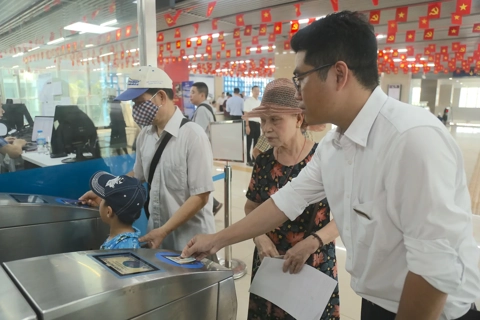
The line will allow residents to travel quickly and conveniently between suburban areas and the city center, while enabling easy transfers to other metro lines. Given its scale and impact, Line No. 5 has been included in the city’s priority investment list and funded by the state budget.
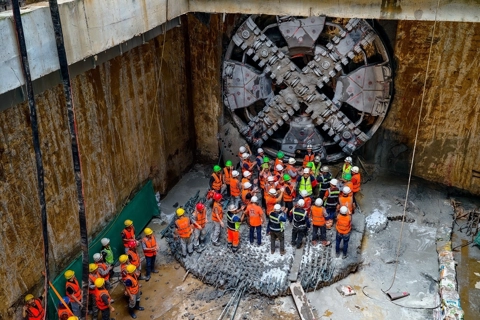
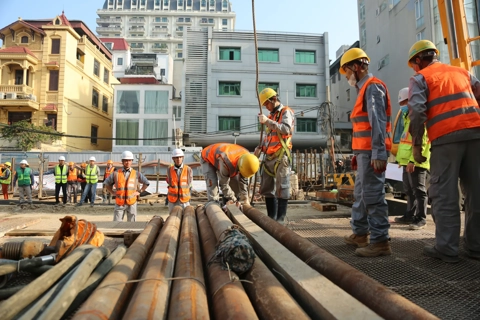
Following the groundbreaking ceremony, the project officially shifted from preparation to on-site implementation on December 20.
Initial drilling and survey work began simultaneously, marking a decisive move into active construction and underscoring Hanoi’s determination to keep this strategic infrastructure project on track. Project managers expect completion to be at least six months ahead of schedule.