Composer Hoang Van's legacy inscribed on UNESCO’s Memory of the World Register
The recognition of the collection is not only a great honor for the musician but an affirmation of Vietnamese music's place in the stream of human intellectual heritage.
THE HANOI TIMES — A collection of the work of Hanoi-born composer Hoang Van (1930-2018) was inscribed on UNESCO’s Memory of the World Register in Paris on April 10.
Between 1951 and 2010, Hoang Van wrote more than 700 pieces. The collection's diversity of form, genre, and musical style reveals a deep interest in Vietnam's cultural and social history, particularly the lives of women and marginalized communities. It also offers valuable insights for scholars studying the development of culture and music in postcolonial Vietnam, as well as cultural exchange within the socialist bloc. Van's collection illustrates the symbiosis between European and Asian musical traditions, highlighting the importance of East-West musical fusion.
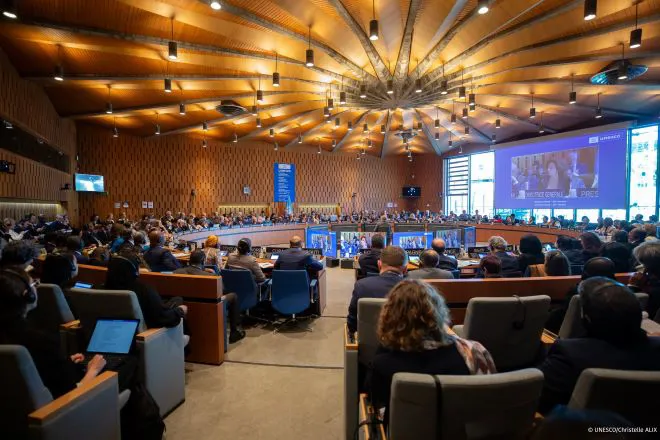
The 221st session of the UNESCO Executive Board on April 10 in Paris, France. Photo: VNA
Deputy Minister of Foreign Affairs Ngo Le Van, head of the Vietnamese delegation to the UNESCO General Conference, said that the recognition of the collection is not only a great honor for the musician but an affirmation of Vietnamese music's place in the stream of human intellectual heritage.
"This is a vivid testament to the enduring vitality of Vietnamese music, a living memory of a historical period that reflects the soul, identity and aspirations of an entire nation in each melody," said Van.
He emphasized the important role of the Memory of the World Program in protecting and promoting global cultural and historical values, and highly appreciated the effective coordination between domestic and international authorities and experts, especially the dedicated contributions of composer Hoang Van's family in preserving this precious collection.
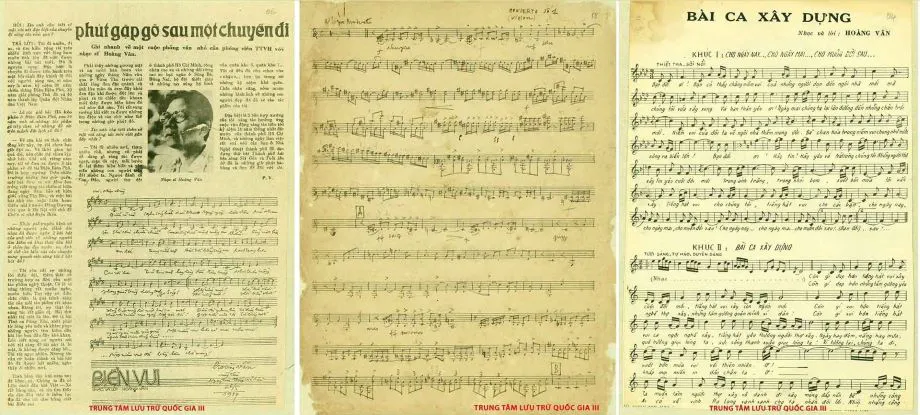
Some works by composer Hoang Van. Photo: National Archives Center III
Ambassador, Permanent Representative of Vietnam to UNESCO Nguyen Thi Van Anh said that the collection, which got absolute approval, is one of 74 dossiers recommended for inscription by UNESCO out of a total of 121 nomination dossiers considered at this session. The dossier was approved smoothly and exceeded expectations, with close coordination among many stakeholders.
Le Thi Hong Van, Director of the Department of Foreign Affairs and Cultural Diplomacy, Ministry of Foreign Affairs, Secretary General of the Vietnam National Commission for UNESCO, said the collection is the 4th world documentary heritage out of a total of 570 world documentary heritages listed by UNESCO so far. It is also the first documentary heritage of Vietnamese music to be registered, contributing to enriching the treasure of national culture and human civilization.
"With the harmonious combination of European classical music and folk music, his works not only have artistic value, but are also valuable documents for researching Vietnamese culture, society and music history," said Van.
In a related move, Vietnam's revised Cultural Heritage Law, which entered into force on July 1, 2025, for the first time devotes a chapter to documentary heritage, demonstrating the growing interest of the state, administrative bodies, and society as a whole in this field.
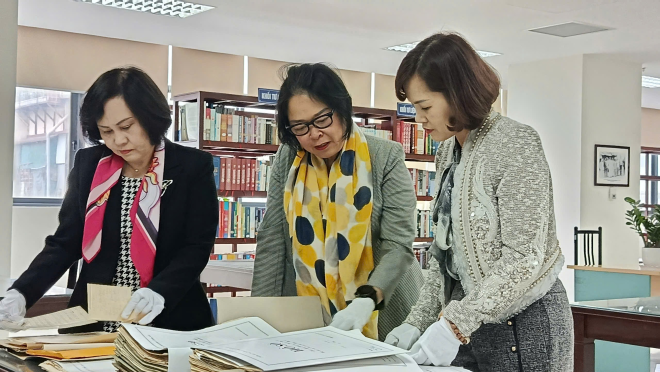
According to the assessment of the International Advisory Council of the UNESCO Memory of the World Program, Vietnam's dossier fully meets international criteria with outstanding values. The collection is well preserved and highly accessible through a multilingual digital platform ( https://hoangvan.org ), contributing to spreading Vietnamese cultural values to the international community.
The composer Hoang Van, whose real name is Le Van Ngo, was born in Hanoi in 1930. At the age of 16, he joined the Revolutionary Youth Union. After 1954, when peace was restored in the north of Vietnam, he was sent to study at the Beijing Conservatory of Music (China).
After graduating in 1960, he returned to conduct the Voice of Vietnam Music Group Orchestra and also served as artistic director, teaching composition and arrangement at the Hanoi Conservatory of Music (until 1989). From 1963 to 1989, he was a member of the Executive Committee of the Vietnam Musicians' Association, Head of the Vocal Composition Department, and worked at the Vietnam Musicians' Association until 1996. He was awarded the Ho Chi Minh Prize for Art and Literature in 2000.
Hoang Van started composing in 1951. His works are closely related to two protracted resistance wars and the country's trades and localities.