Hanoi to invest US$226M in streets and service roads under Ring Road No.4 project
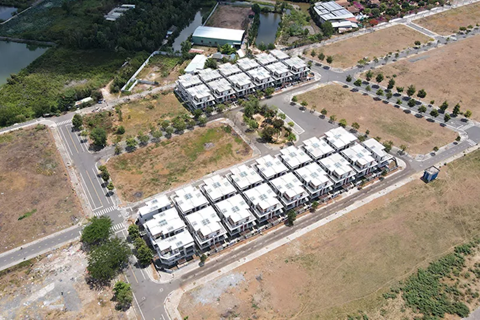
The project aims to construct a system of local street and service roads spanning approximately 58.2km in Hanoi.
Hanoi is set to allocate VND5.4 trillion (US$226 million) to building service roads under Ring Road No.4 project.
| The design of Ring Road No.4 |

The project aims to build a system of streets and service roads spanning approximately 58.2km in Hanoi.
Ring Road No.4 runs through Hanoi in Tan Dan commune, Soc Son district, to the boundary between Hanoi and Hung Yen Province in Thuong Tin district.
The route passes through seven districts, including Ha Dong, Soc Son, Me Linh, Dan Phuong, Hoai Duc, Thanh Oai, and Thuong Tin. Its right service road runs a distance of about 51.61 km, while the left service road is approximately 51.55 km long.
The local streets are designed to meet the standards of the urban main thoroughfare with a design speed of 80km/h. However, the section running parallel to Song Phuong Dam is designed to meet the standards for secondary main roads with a design speed of 60km/h.
Intersections that require the construction of interchanges will be built in conjunction with Component 3 of the Ring Road No.4 project.
Intersections with provincial roads, national roads and other busy urban axes requiring complex traffic organization will be controlled traffic lights and painted lines with guide signs to ensure safety during operation.
The total investment for the project is VND5.38 trillion ($226 million), with VND4.52 trillion ($190 million) allocated from the city budget for construction costs.
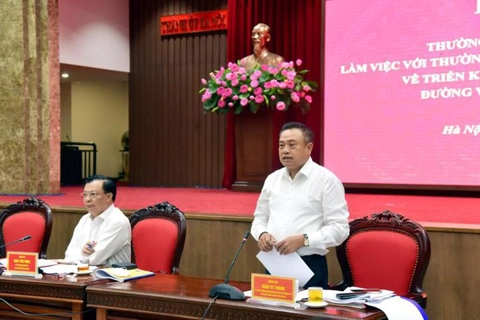
The Chairman of the Hanoi People's Committee has appointed the Hanoi City Traffic Construction Investment Project Management Board to ensure the accuracy of the volume and funding, and the capacity of organizations and individuals to conduct surveys and draft feasibility study reports.
This body must also make an overall and detailed plan and schedule for the implementation of the investment project, and comply with regulations on the investment policy of the Ring Road No.4 project.
The Ring Road No.4 project involves the construction of a total distance of 112.8 km, comprising 103 km of Ring Road No.4 and a 9.7 km route connecting to the Noi Bai - Ha Long Expressway. The route covers 58.2 km through Hanoi, 19.3 km in Hung Yen, and 25.6 km in Bac Ninh while the connecting route is 9.71 km long. The project is designed as a 4-lane expressway with a width of 17m and a design speed of 80 km/h.Service roads will be constructed on both sides of the road through urban and residential areas. The investment for the project will be a combination of public and PPP investment, with a preliminary estimated investment of about VND86 trillion ($3.6 billion). The budget requirement for the 2026-2030 period is VND6.21 trillion ($260.7 million), with VND2.75 trillion ($115.4 million) from the central budget and VND3.46 trillion ($145.2 million) from the local budget of which, Hanoi contributes VND2.13 trillion ($89.4 million), while Hung Yen and Bac Ninh contribute VND230 billion ($9.65 million) and VND1.1 trillion ($46.17 million), respectively. |