Optimal plan is to create constant flow for Hanoi’s dying river: Experts
The To Lich river’s landscape needs to be renovated by collecting all sewage for treatment, that ensures environmental standards before it is discharged back into the river.
The plan to use the West Lake to relay water from the Red river to the To Lich river via a pump station will help improve significantly water quality in the To Lich river, which has been severely contaminated for decades, and create a constant flow, according to experts.
Despite the shortcomings and inadequacies, the above-mentioned measure is currently the most reasonable solution, especially when Yen Xa wastewater treatment site is yet to be put into operation and building a sewage collection system along the To Lich river is still at a planning phase, experts said.
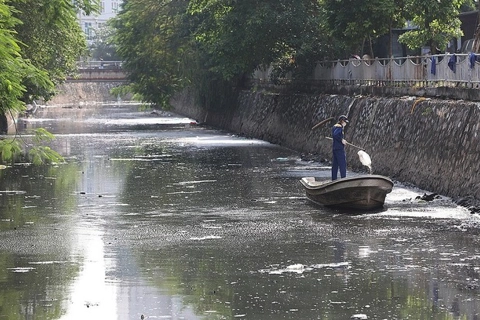
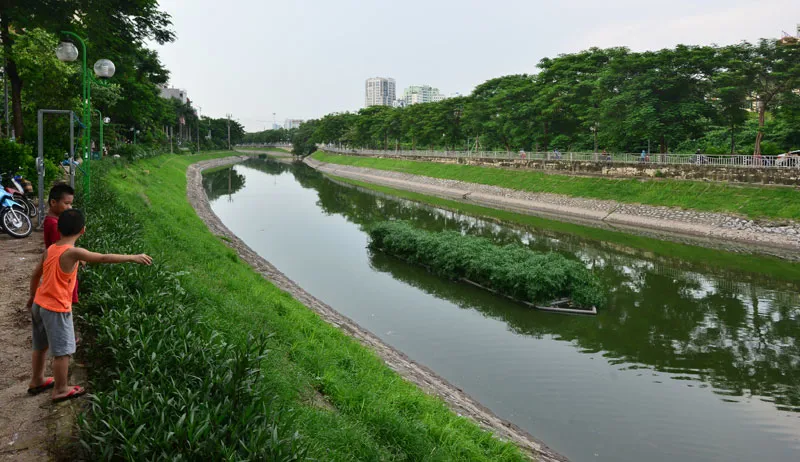
| A section of Hanoi’s To Lich river. Photo: Cong Hung |
Le Minh Chau, former director of Hanoi Drainage Company said that not only will the environment of the West Lake and the To Lich river be improved when receiving water from the Red river but it also improves the city's landscape and preserves historical values.
“Specifically, after the renovation of the West Lake and the To Lich river, we can consider connecting with other lakes like Thu Le lake, Yen Duyen lake and Yen So lake by a canal, creating a water traffic route through Hanoi city,” Chau explained.
Former Director of the Hanoi Drainage Project Management Board Pham Van Cuong added that the Hanoi government plans to build a fountain, cultural works in Quang An (Tay Ho district), plant more trees, decorate the West Lake to create an entertainment space for the capital city’s residents.
Dr. Tran Duc Ha, director of the Research Institute for Water Supply and Sewerage under the Vietnam Water Supply and Sewerage Association, said the To Lich river’s landscape needs to be renovated by collecting all sewage with a total flow of 300,000 - 350,000 cubic meters per day for treatment that ensures environmental standards before it is discharged back into the river.
However, the Hanoi government also needs to pay attention to flow generation and enhance the self-cleaning process in the river in the dry season by supplying clean water to help create a constant flow for the To Lich river, Ha added.
“Rivers must flow, and with such synchronous and methodical solutions, cleaning and creating flow for the To Lich river is feasible,” Ha stressed.
The To Lich river used to be a branch of the Red river but was delinked by the French in 1889 as part of an urbanization plan. The river runs 14 kilometers through the districts of Thanh Xuan, Hoang Mai and Thanh Tri and has become infamous for its stench and blackish water.
Currently, rain is the only clean source of clean water for the river since it is fed mostly by sewage.
Hanoi city has piloted a host of measures to revive the To Lich river which is dying due to heavy pollution and massive accumulation of mud in the river bed, including the application of Japanese and German technologies.