Real estate credit surge prompts tighter oversight to safeguard Vietnam’s financial stability
Vietnam’s real estate sector has absorbed a sharp rise in credit, supporting market recovery while raising concerns over capital concentration, speculative risks and the need for tighter policy coordination.
THE HANOI TIMES — Outstanding credit for real estate business activities in Vietnam rose 28% during last year to exceed VND2 quadrillion (US$76 billion) by the end of November 2025, Ministry of Construction has reported, citing data from the State Bank of Vietnam.
The ministry reported that outstanding loans for realty sector expand steadily throughout the year from more than VND1.56 quadrillion ($59.4 billion) in Q1/2025.
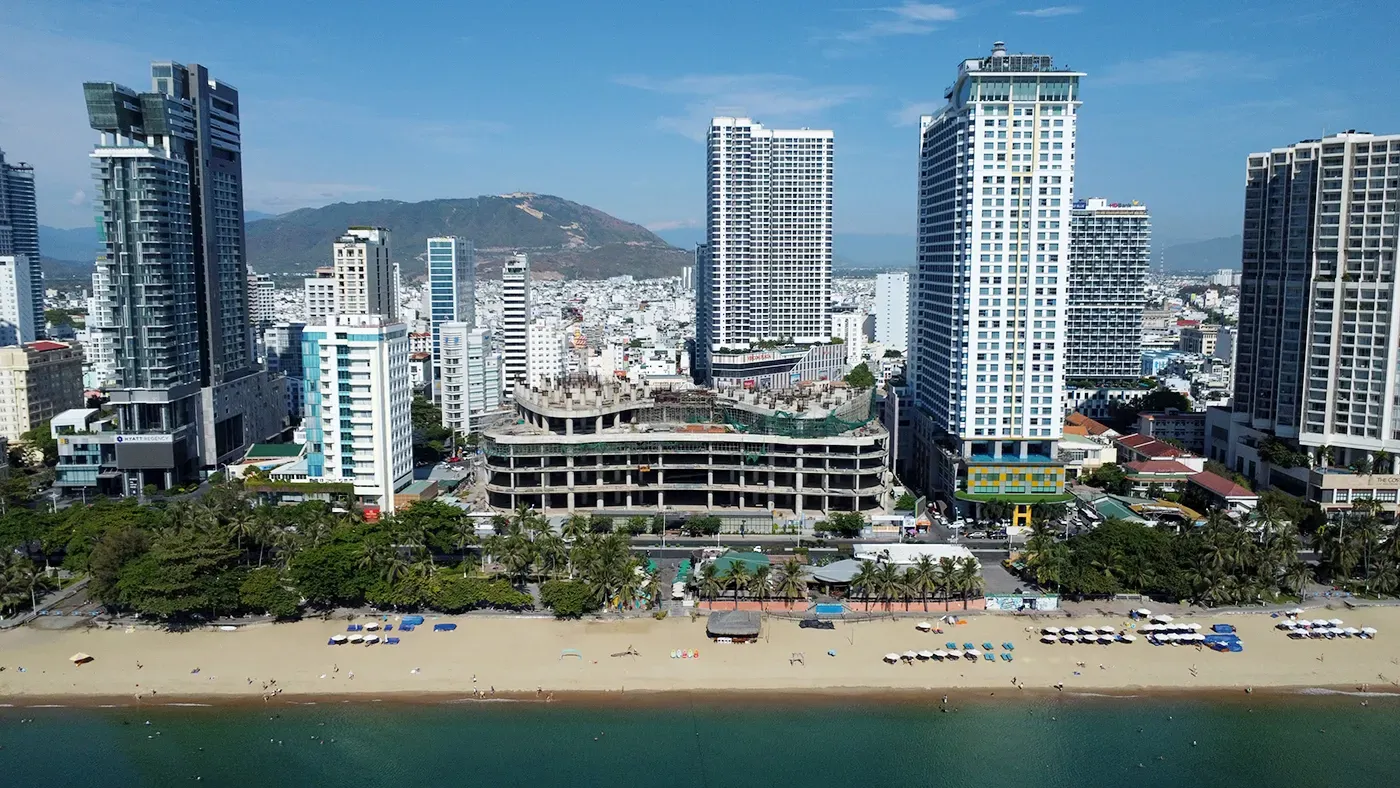
Hotels and real estate projects on the coast of Nha Trang, Khanh Hoa Province. Photo: Trung Nhan/The Hanoi Times
Outstanding credit for urban development and housing construction projects reached VND628.6 trillion ($24 billion). Loans for office leasing totaled VND61.8 trillion ($2.3 billion), while credit for industrial parks and export processing zones reached VND123 trillion ($4.7 billion).
Lending for housing construction and renovation for sale or lease reached nearly VND140 trillion ($5.3 billion) while loans for land-use rights purchases totaled VND226 trillion ($8.6 billion).
The corporate bond market also recorded sharp fluctuations. The share of real estate bonds in total issuance rose from 7.4% in October to 38.6% in November, before easing to 28% in December 2025. Strong issuance late in the year suggests improved access to capital, even as interest rate pressure persists.
By the end of 2025, the real estate sector attracted $8.1 billion in newly registered foreign direct investment, accounting for more than 21% of total FDI and rising nearly 13% year on year.
The central bank’s figures show total credit growth across the banking system reached about 19% by year-end, with outstanding loans totaling VND18.6 quadrillion ($707.4 billion), higher than previously reported.
While this expansion has supported economic recovery, it has also increased pressure on policy management and risk control.
Real estate credit growth of 20%-30% significantly exceeds overall system credit growth of about 19%. Loans for real estate investment and business rose roughly 24%, while lending for home purchases and renovation increased about 14.5%.
These figures confirm that real estate continues to absorb a large share of capital. At some banks, real estate loans account for up to 30% of total outstanding credit and as much as 58% of corporate lending, underscoring elevated exposure in a highly sensitive sector. Real estate remains a core pillar of the economy, contributing significantly to GDP and linking to dozens of related industries.
Associate Professor Vu Mai Chi, head of the Banking and Monetary Department at the Banking Academy, warned that excessive concentration of capital in real estate could lead to stagnation rather than sustainable growth.
She said capital should shift more decisively toward production, business activities and priority sectors to support long-term expansion.
Economist Vo Tri Thanh noted that many capital flows still target segments that do not meet genuine housing demand, fueling price inflation, speculation and asset bubble risks.
However, he stressed that gradual and well-calibrated credit controls would help avoid sudden shocks to the market and the broader economy.
Pham Thi Thanh Hoai, a board member of VietinBank, said the real estate market remains anchored at high price levels while liquidity has weakened, especially in luxury and high-end segments.
She said risks remain manageable for now, but pressures could intensify ahead.
In response, VietinBank has maintained a stable real estate lending structure for both corporate borrowers and homebuyers and has not withdrawn from the sector.
Steering bank lending into less risky sectors
Against this backdrop, Prime Minister Pham Minh Chinh has ask the central bank to tighten oversight of real estate credit and curb speculative capital flows that distort the market, as overall credit growth this year is expected at around 15%.
At a meeting of the Central Steering Committee on Housing Policy and the Real Estate Market in late December 2025, the prime minister urged regulators to strengthen risk management for credit flowing into the sector.
The Ministry of Construction said it will continue close coordination with the State Bank and the Ministry of Finance to control real estate credit, limit speculative flows and safeguard financial system stability while supporting healthy market development.
The ministry also called on the central bank to closely monitor real estate lending and instruct credit institutions to ensure system security and tackle capital speculation.

Buyers at a land auction hosted by Tien Thang Commune authorities in Hanoi last December. Photo: Pham Hung/The Hanoi Times
In addition, the ministry pressed for faster disbursement of the VND145-trillion ($5.5 billion) credit package for social and worker housing, along with expanded lending for people under 35. It also called for stronger data sharing to support the national housing and real estate market information system.
In a recent directive on credit growth for 2026, the State Bank required each bank to ensure real estate credit growth does not exceed overall credit growth in 2025 and take measures to steer capital toward production and priority sectors, thus guaranteeing system safety.
Financial experts said stricter credit discipline aims to remove highly leveraged developers that rely heavily on bank borrowing, limit bad debt and reduce systemic banking risks.
Economist Can Van Luc said real estate firms must strengthen forecasting and risk management, particularly regarding interest rates and cash flow.
He urged developers to abandon scattered investment strategies and concentrate resources on projects with clear legal status, strong demand and alignment with market needs.
Product restructuring remains essential, he said, as it improves liquidity and access to policy-backed credit.
Economist Vo Tri Thanh warned that misdirected capital flowing into speculative segments, land subdivision and price manipulation could inflate asset bubbles.
“Gradual and well-designed credit controls will help avoid sudden shocks to the economy,” he told The Hanoi Times.
“At this stage, credit policy should channel capital toward new growth drivers such as green transition and infrastructure, while expanding social and commercial housing supply to better balance prices and demand.”
Tran Ngoc Bau, CEO of WiGroup, said banks’ preference for real estate lending remains difficult to avoid because of the strong overlap between credit supply and demand.
He said real estate remains one of the few sectors capable of absorbing large volumes of bank credit quickly and at scale.
Pressure to accelerate profits after years of slow returns has pushed banks to expand lending as recovery signals strengthen and monetary policy eases, Bau said.
“In this context, real estate becomes highly attractive due to large loan sizes, clear collateral and strong short-term returns,” he said.
He added that when profit targets dominate, banks naturally favor sectors offering faster and more predictable returns, with real estate playing a central role.
According to Bau, the State Bank’s directive sends a clear signal that the economy and banking system cannot continue to rely excessively on real estate and that the policy serves as a necessary test before longer-term adjustments.
Capping real estate credit growth early allows banks to allocate capital more proactively and avoid excessive concentration, he said.
The move also forces developers and investors to adopt more cautious financial planning instead of assuming unlimited bank capital.
Bau said the policy supports more sustainable real estate development and reduces short-term banking risks.
“At the same time, the State Bank retains flexibility, as shown in 2025 when actual credit growth exceeded 19%, surpassing the initial target of 16%,” he said.