Smarter planning to help Hanoi tackle urban flooding: Experts
Hanoi can turn flooding challenges into opportunities by improving elevation planning, integrating drainage, protecting water surfaces and adopting smart city solutions.
THE HANOI TIMES — Experts warn that inadequate ground elevation management is a major factor behind flooding in Hanoi’s new urban areas, calling for smarter and more sustainable planning.
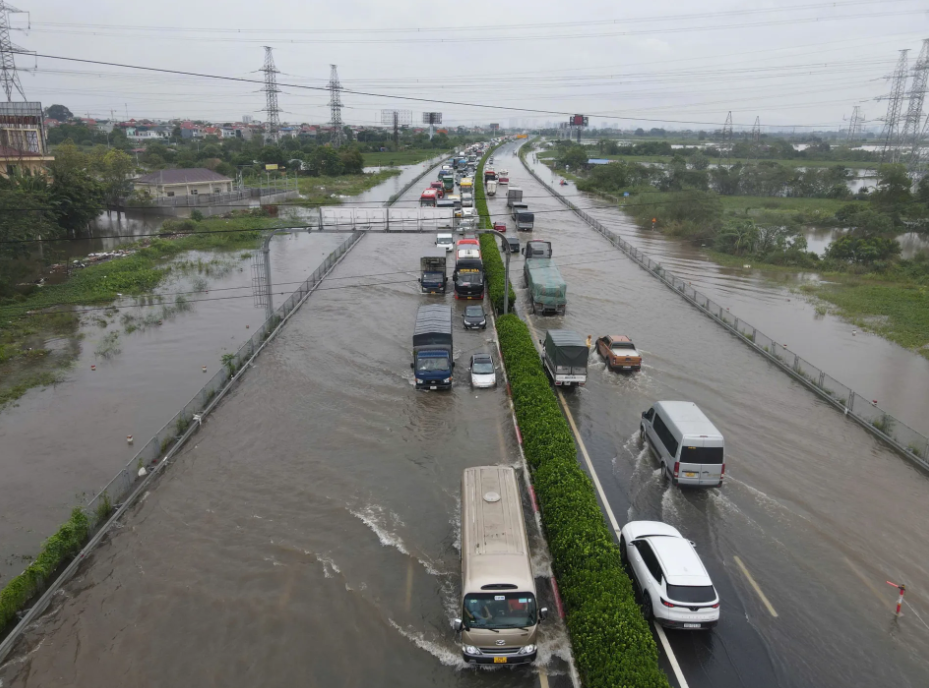
Phap Van – Cau Gie Expressway after a heavy downpour. Photo: Pham Cong/The Hanoi Times
Chronic problem
Since early 2025, Hanoi has been hit by dozens of storms, bringing prolonged heavy rains that left many new urban areas in the city’s west, including Duong Noi, Geleximco Le Trong Tan and Van Khe, submerged under 0.3 to 0.7 meters of water.
Images of residents “rowing boats” through modern urban neighborhoods once again raised alarms about the city’s drainage infrastructure. What troubles residents most is particularly concerning is that flooding in these areas often lingers for days after the rain stops, disrupting daily life, traffic and businesses.
According to Nguyen Van Tuan, a resident of Van Khe Urban Area, the main cause lies in the lack of integration between new urban projects and the city’s central drainage system.
“Low ground elevation combined with unfinished or undersized drainage facilities has forced residents to live with flooding year after year,” he said.
In response, Hanoi’s Department of Construction has instructed developers to work with local authorities to urgently review the situation and implement storage reservoirs and pumping stations to discharge water from low-lying areas into the city’s main drainage system.
These underground tanks, with large storage capacity, can temporarily hold stormwater and then pump it into rivers and canals when flows permit.
A department representative said that this is only an interim solution: “Developers must take responsibility for urban infrastructure instead of focusing solely on building and selling houses.”
Architect Tran Tuan Anh noted that underground reservoirs and pumping stations can ease pressure on local drainage networks. They allow stormwater to be held temporarily when heavy rainfall exceeds system capacity and then pumped out even when the city’s drainage system is overloaded.
This approach is faster to deploy than overhauling the entire network. However, he emphasized that such measures are only “painkillers.”
“If ground elevation is poorly planned and drainage is not connected to the citywide network, flooding will inevitably return,” said Anh.
According to him, rainwater in cities must follow the natural principle of flowing from high to low into rivers and lakes.
“If developers level land arbitrarily, build in low-lying areas, and ignore elevation planning, no technical fix can solve the problem,” he asserted.
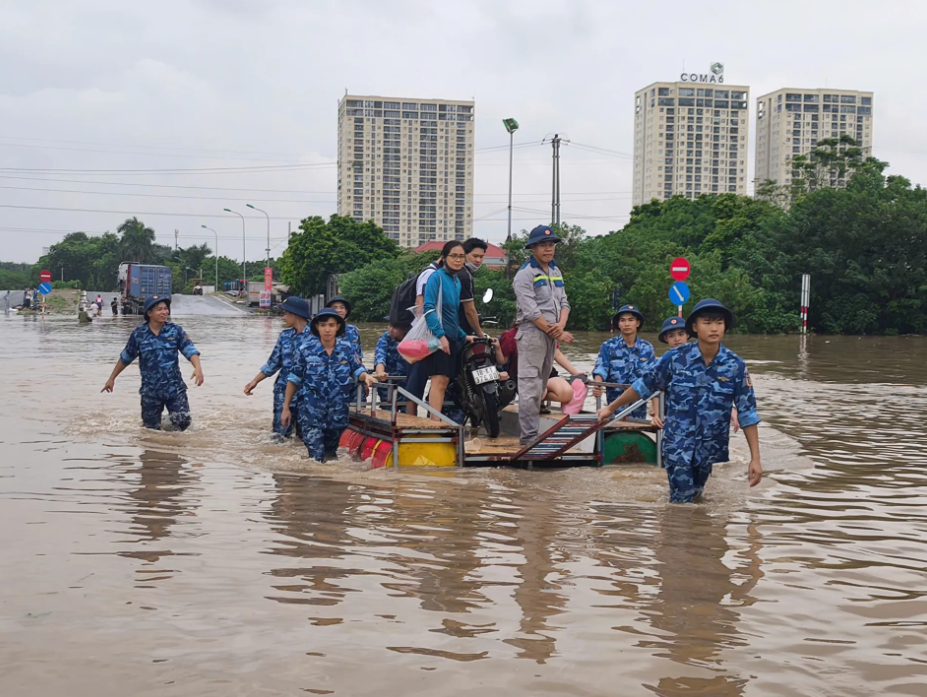
Local authorities assist residents through flooded areas on Thang Long Boulevard in Hanoi on the morning of October 1. Photo: Pham Hung/The Hanoi Times
Smarter planning remains key
Anh also pointed out that weak enforcement of elevation planning is a root cause of severe flooding in many new urban areas.
“In some projects, elevation planning was neglected. Developers built houses and internal roads but installed token drainage systems, leaving residents to face the consequences. Worse, infrastructure was often handed over unfinished, with little inspection, and once houses were sold, developers withdrew and left the burden to local authorities and residents,” he said.
Experts agree that solving the “rain means flood” problem requires a combination of measures: strict enforcement of elevation planning, mandatory compliance with the city’s elevation map and drainage master plan, and clear connection points between urban drainage systems and the citywide network.
Economist Dinh Trong Thinh suggested that Hanoi must protect and restore its natural water surfaces.
He noted kakes, ponds and canals are not only landscape features but essential regulators of stormwater, and filling them for construction must be strictly prohibited.
The city should also adopt sustainable drainage technologies, such as the “sponge city” model pioneered in China, while clarifying the legal and financial responsibility of developers to fix flooding in their projects.
Thinh stressed that urban flooding cannot be solved solely through the city budget. “Developers, as direct beneficiaries, must contribute to the cost of building and maintaining drainage infrastructure. Hanoi should also promote public-private partnerships and attract technology companies to develop sustainable flood-control solutions,” he said.
International experience offers valuable lessons. Tokyo built massive underground water storage tunnels to capture stormwater and pump it into rivers, reducing urban flooding.
Singapore integrates green infrastructure such as retention lakes and eco-parks with modern drainage and even reuses stormwater.
Shanghai is advancing the sponge city model, expanding natural infiltration areas rather than relying only on pipes and sewers.
These examples show that lasting solutions require integration of planning, infrastructure, technology and ecology, Thinh added.
Dao Ngoc Nghiem, Vice President of the Vietnam Urban Planning and Development Association, highlighted the need to revisit Hanoi’s elevation planning.
“The western districts are naturally low-lying and urbanized too quickly, erasing ponds and lakes. While underground reservoirs and pumps are needed, restoring natural retention lakes and canals is equally important. Without them, flooding in new urban areas will persist,” Nghiem said.
Echoing Nghiem, former Director General of the Technical Infrastructure Department Assoc. Prof. Dr. Nguyen Hong Tien stressed that the recurring floods in Hanoi’s western urban districts reflect not just technical shortcomings in drainage but also weaknesses in planning and developer accountability.
“Underground reservoirs and pumps can provide temporary relief, but the real solution lies in stricter elevation management, synchronized drainage infrastructure, protection of natural water surfaces and the application of smart city technologies,” he said.